Friday, 24 May 2013

Leah Mellors – Community History Cataloguing Internship Report


Leah Mellors – Community History Cataloguing Internship Report

I have spent 30 days working with Marek Romaniszyn, in the Community History team at Leeds Museum Discovery Centre, documenting his digital film archive and a collection of London 2012 Olympic and Paralympic objects.
Community Film Archive

The digital film archive contained around 70 films that needed to be documented retrospectively. The films included the ‘Contemporary Collectors’ series, the ‘Faith in the City’ series and the ‘A Greener City’ series and most had accompanied an exhibition or display in the Leeds City Museum. I watched each film, taking detailed notes on what was said by the interviewees and, where possible, took direct quotations from the films. These quotations helped to give a greater insight into the content of the films but also gave some of the descriptions a more light-hearted feel. Having taken detailed notes, I documented each film on ‘The Museum System’ database, recording information such as provenance, constituents, exhibition history and date. I wrote a comprehensive description of each film, which could also be used on the website.

Having ensured that each film had a full database record, we needed to create a DVD playable copy and a MP4 data copy of each film. I burned a MP4 data copy of each film onto an archival-grade disc, whilst the DVD copies were burned by an external party, as the software was not available to us. Each disc was labelled with its title and accession number and placed in storage boxes. Seeing all 140 discs neatly labelled and lined up in their storage boxes was surprisingly satisfying! All the films were then placed in the Discovery Centre store and located on the database.


Not only did this project give me a thorough understanding of documentation using a museum database, it also gave me a really good insight into oral history films and how they can be used to complement an exhibition. It was fascinating to hear people’s experiences and memories and I learnt a lot about Leeds and the different perspectives, cultures and faiths in the city. By far my favourite series of films was ‘Faith in the City’: I have always been interested in religion and belief and these films taught me a great deal about different faiths, from the first-hand perspective of ordinary people practising religion in Leeds.
 

London 2012 Olympic and Paralympic collection

Alongside the documentation of the digital film archive, I also documented a collection of London 2012 Olympic and Paralympic objects that had been collected by Marek. Many of these objects related to the Olympic and Paralympic experience in Leeds and included the lamp that carried the Paralympic flame to Leeds and a wheel-guard from the Canadian Wheelchair Rugby team, who stayed in Leeds to complete their pre-Games training.

I completed the documentation process of these objects from start to finish. Firstly, I assisted with ‘Entry’ and ‘Transfer of Title’ forms, to accession the objects. Then, I labelled the objects with their accession numbers, either writing the number onto the object using ink and varnish or writing the number onto cotton tape and sewing this into textile items. I photographed the objects before recording information such as date, provenance, materials, dimensions and physical condition. Some research into the context of the objects was also required. All of this information was input onto ‘The Museum System’ database, before the objects were packed into boxes and stored in the Discovery Centre store.


As with the digital film archive, this project taught me about the documentation process for objects and the minimum standard of information required. It was really useful to see the entire process from beginning to end. I also learnt how to pack objects with acid-free tissue paper, using rolls of tissue-paper to cushion the folds of textiles. More than anything, this project improved my confidence when handling objects and an unexpected bonus was a slight improvement in my sewing skills!

I have really enjoyed my time as an intern here and have gained valuable experience, especially in documentation. I have also gained a good awareness of conservation and outreach work, simply by speaking to members of staff and sitting-in on outreach sessions. I have recently secured a full-time curatorial traineeship at the Herbert Museum in Coventry and the skills and experience I learnt during my internship at the Discovery Centre undoubtedly helped me to secure this job. I am very grateful to have been given such a great opportunity. 

Leah Mellors April 2013


Monday, 20 May 2013

Two Tiny Roman Treasures

A guest blog-post by ...

Ian Marshman,
School of Archaeology & Ancient History, University of Leicester

I made the not-too-taxing train journey from Leicester to Leeds to take a look at two unusual silver finger rings in the museum’s collections. Both date to the late Roman period and came from the countryside about 10 miles west of modern Leeds.

The first ring (below) was uncovered during excavations at one of the wealthiest settlements in Roman West Yorkshire, the villa at Dalton Parlours (near Boston Spa). It was found at the bottom of a deep well, which the owner’s used as their main source of water. The ring shows signs of having been deliberately broken, and it may have been thrown down the well as an offering. Its owner might have hoped the gift would persuade the gods’ to keep the new well full of clean water, or perhaps just to get good luck! The ring is made of silver and is set with a piece of marbled glass moulded with the image of a ‘stick man’ holding a staff or spear. We can’t be sure what its owner thought of the figure, but it may been a warrior god such as Mars.


The second ring (below) was found by a local metal detectorist who was searching in the fields near the A1(M) not far from Micklefield. He promptly reported it to a member of the Portable Antiquities Scheme so that it could be recorded on their database. Since it was more than 300 years old and made of silver, the ring was declared ‘Treasure’ and donated to Leeds City Museum. This ring would have been much more valuable than the one from Dalton Parlours because it was set with an engraved carnelian gemstone. Gems like this came from right across the Roman Empire from the Sahara desert and even India. The intricate engraving shows the goddess Fortuna holding a cornucopia (horn of plenty) and steering a ruder, and would have been cut by a skilled craftsman - evidently with very good eyesight! Signet rings like this were used for sealing documents, and by choosing an image of Fortuna, its owner could express their wishes of good fortune whenever they sent a letter or signed a contract. The gem is rather worn and it must have been used for a long time, and was probably an heirloom by the time it was lost in the fields near Micklefield.


My PhD research has involved cataloguing Roman signet rings like these from right across Britain. By doing so, I hope to be able to study the way people in different parts of the province chose different images for their seals, and the kinds of messages they might have expressed. The Romans used a huge range of images on their seals, from heroes, gods and goddesses to animals, symbols and scenes from daily life. As well as this I will also be studying the types of gemstones that were popular. This is can be particularly interesting because ancient people believed different gems possessed different magical powers, which could do everything from give luck to a soldier on the battlefield to even preventing drunkenness! These two rings from rural West Yorkshire will be added to those in my database to help me study how people right across Britain used such objects about 1,700 years ago.

Good Luck with the rest of your research, Ian. This is a fascinating project that the collections here in Leeds are proud to have made a contribution to.


Thursday, 2 May 2013

West Dean College furniture conservation students visit Temple Newsam House

West Dean College is a very special educational institution near Chichester, West Sussex. It was the place where I studied and trained in furniture conservation after my training and experiences in cabinetmaking, design and joinery. West Dean College first year furniture conservation students, and their tutor, Norbert Gutowski, visited Temple Newsam House today. As one of the great decorative arts museums in the UK, with an outstanding furniture collection, Temple Newsam has long been a standard visit every year for West Dean students, both furniture, and clocks. And as usual a very international lot they were, the students coming from Poland, New Zealand, Germany and England.

http://www.westdean.org.uk/WestDeanHomepage.aspx

Posted by Ian Fraser


Tuesday, 23 April 2013

You've been framed!


Madonna and Child tablet conserved
but needing a frame for display.


Detail of moulding being carved

Making things that are curved can be interesting technical challenges. The Madonna and Child tablet that has undergone conservation works is for display at Temple Newsam House. Missing its frame, a new one, of an appropriate design for the 17th century, is being made in Temple Newsam's conservation department. Starting from the tablet a template was made, and then divided into four pieces. Oak was chosen for its strength and density; softwood would be easier to carve, but because the tablet is heavy, and softwood is also prone to some movement and splitting, this makes it less than ideal for framing the sort of object we are talking about here. It is also historically accurate, oak would likely have been used in this instance, and certainly all good church and cathedral joinery is done in oak. Four pieces of quarter sawn oak were rough shaped, and their ends precisely surfaced so that the ends met cleanly. Quarter sawn oak is very straight grained, and stable. The four pieces were glued together under the pressure of a web cramp. After the glue had set a floating tenon was let in across each of the four joints. Precisely shaping the inside and outside curves was the next step. This was followed by laying out with a sharp pencil the lines of the mouldings to be carved, the carving. This was done entirely with an old hacksaw blade that I ground to make a kind of planing knife. It worked surprisingly well, and the carving was quicker than I thought it would be. Keeping the edge sharp is essential, of course. So, regularly, it is over to the diamond grit lapping stone to get an edge back, and then giving the new edge a tickle on the polishing wheel. Wicked edge achieved! Over the coming days I will update with all the procedures, because eventually this frame will be watergilded, and then toned down to give the sort of appearance of an old gilded surface.


Frame in oak being fabricated and shaped.
With the moulding carved and smoothed the frame is ready
for the next stages.


Onto the bare oak a coat of rabbit skin glue size is brushed on. Mixed 1 part rabbit skin glue granules to 10 parts water, and then gently heated into solution. The subsequent layers of gesso is the size in the same dilution with chalk (calcium carbonate) mixed in. More about gesso and its purpose when we get to that stage. The hot size when applied to the oak will be absorbed a long way into the timber. This will prevent excess rabbit skin glue in the gesso being absorbed into the oak. This would weaken the gesso and make it crumbly. The size also helps with bonding the gesso to the wood, forming a chemical bridge between the two. Powerful hydrogen bonding takes place between the size and the wood, and the size and the gesso, an interface between the wood and the gesso, and absorbed into both.


Rabbit skin glue size being brushed and worked
into the surface of the wood that will be gilded.
Gesso is a mixture of the rabbit skin glue size and powdered chalk. Its purpose is to enable an extremely smooth surface, on the item being gilded, to be created. The binding medium, rabbit skin glue is also used in the subsequent layers, the bole, and the size water applied at the gilding stage. The size water activates the dry glue in the gesso and bole, and bonds the gold leaf down to the surface.

Powdered chalk is mixed into the
size to make gesso. Enough chalk is mixed in
until the gesso has the appearance and
consistency of single cream.


Several coats, at least 12, of gesso are applied to the substrate.
The coats should all be applied the same day to ensure the
layers bond properly.

After enough gesso has been built up it needs smoothing,
and re-capturing of the detail that has gotten a little clogged up
with gesso. This is done with abrasive papers. Also with "water-
polishing". Fine cotton cloth slightly dampened slightly
dissolves the surface and allows a little re-distribution and smoothing.

Application of bole is the next stage. Bole is made of rabbit
skin glue size, and very fine grain coloured clays. Here
the clay is being crushed and mixed with water before being
added to the size.


Here the clay and size have been mixed, filtered for smoothness
and is ready to apply, fairly hot.

 Several coats of bole are applied. Yellow colour bole, and red bole
on areas that will be burnished (more about that at the
application of gold leaf stage!).

The coats of bole are made extremely smooth with
a succession of abrasive papers, finishing with
an abrasive of at least 6000 grit. Effectively this
action is polishing the bole. The surfaces are now
ready to receive the gold leaf.

Gold leaf is extremely thin. In water gilding it is bonded to the substrate by the glue in the bole and the gesso. This is re-activated with water. To help bonding further a little rabbit skin glue size is added to the water. A little ethanol (a kind of alcohol) is added too. This helps to break the surface tension of the water and helps it to wet the surface instead of beading. Gilders call this solution "size water". The gold leaf is cut to manageable, suitable, sizes and shapes with a gilder's knife. The gold is supported on a gilder's cushion at this stage, having been drawn out of the book of gold leaf it was stored in. A gilder's tip is a kind of wide, fine brush. It is used to pick the gold up. It has to be slightly sticky so that the gold transfers to the tip. I put a little Vaseline on the back of my left hand, and periodically, when the gold no longer stays on the tip, brush the tip over the Vaseline.

Laying the gold leaf

Picking up gold leaf with a kind of brush called a gilder's tip

Size water is applied to the bole. This activates the glue
in the bole, and gesso. As the water is drawn into
the porous surface the gold leaf is sucked down onto
the surface, and is bonded by the glue.
All the gold leaf down. Next step, after the gilding has
dried, is to dust off the excess, and then burnish the
two round mouldings.

Some hours after applying the gold leaf the gesso reaches the right
moisture content for burnishing. The tool for this is a polished agate stone.
Gentle pressure compresses the gesso and gold, and brings about
a deep and lustrous shine.

The tablet has been offered into the frame's rebate. Two battens
are carefully shaped to the contours of the back of the tablet.
When fixed into place the battens apply no tension to the
tablet. Plaster behaves well under compression. The same cannot
be said for its being under tension!
The frame has been toned down with some coats of weak size
with black and brown watercolour mixed in. This is very effective
in giving an aged appearance, taking down the very bright, new gold
without detracting from its lustre. Ready for installation by
Temple Newsam's technicians. Fait accompli!

Posted by Ian Fraser


Thursday, 11 April 2013

Magic and Mystery Session at Leeds Museum Discovery Centre

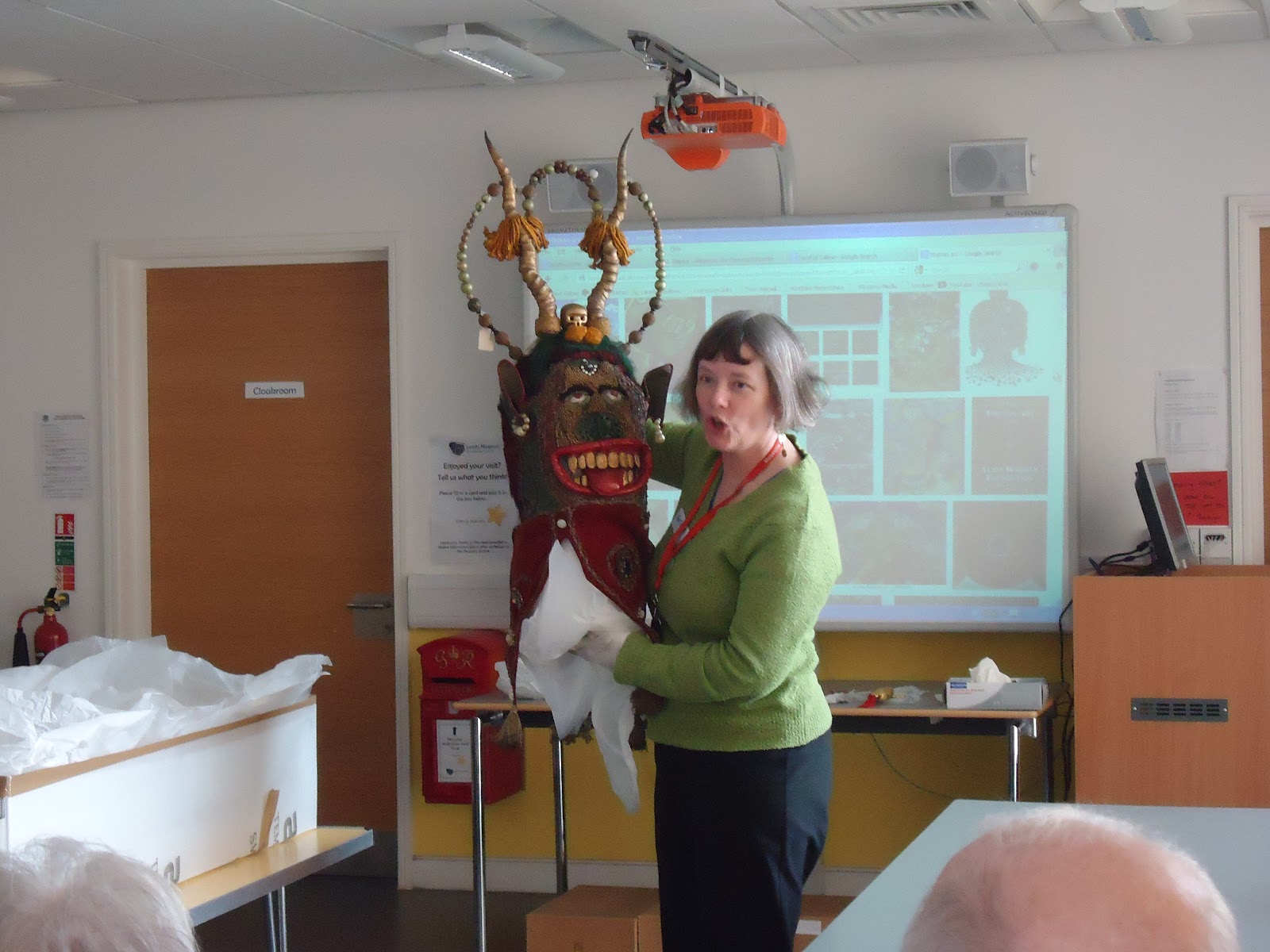
This spring the Community History Team at Leeds Museums and Galleries are working with a Peer Support Group, and colleagues from the West Yorkshire Playhouse on the topic of Magic and Mystery. On Tuesday we took a quick look at the ritual practices in Tibet, as Tibetan religious art is famous for its use of human bone – usually the bone of respected priests and abbots, who have shown special spiritual powers during their life-times.  

A star item was this mounted skull cup, or Kapala, one of two in the collections (the other was shown in the recent Treasured exhibition at Leeds City Museum, see the detail on the poster). On this cup you can see the human cranium clearly, sitting on the triangular brass stand beneath the encased cover (whose handle knob is now missing). The cover is rather battered but you can still see deity images and key words in Lautsa script round the sides. The cup was found in a Bradford attic in 1962 and taken to Mr S Jackson at Bradford Museum, who gave it to a Mr K Wilson, in  Ilkley, to take in to Abbey House Museum.  It is amazingly similar to one at the British Museum http://goo.gl/UH2oO.
 
Mysterious in a different way is this masquerade set, supposedly from the Himalayas, purchased by the museum from Ye Olde Antique Shop, Denholme, in 1975. But if you look closely many aspects of these items reflect a more European style, possibly of New Age performance of belief.

The horned mask has a face made of green leather with red leather lips and a large tongue and gold leather teeth. The nose area seems to be made from a flattened a pierced metal implement, like a masher for vegetables, or a type of hoe for weeding. Large numbers of gilded beads are glued onto the face on the cheeks and forehead. The back of the head is made of red and black woollen fabric, woven and felted, with green wool hair attached. The two horns are of gilded wood and a small carved and gilded skull sits between them. Wire loops threaded with large wooden beads, glass beads and yellow wool tassels and pom-poms rise around the horns. Below the mask are four red velvet flaps which would cover the wearer's shoulder. They are trimmed with curled and coiled foil braid and modern costume jewellery that is clipped on (some of which does feel like marble, and is carved with roses in a Chinese style). The mask also came with a skirt or apron, a drum and a wand. The skirt is very European looking, and we have not been able to understand or translate the symbols on it. The drum is painted with a very European looking dragon, and some Chinese characters, and the wand has a crocodile head which looks as if it belonged to English pantomime.


We are not sure which character the mask represents, or which dance or performance it would have been worn for. The owner of the antique shop who sold the objects to us described the set as a 'Devil Dancer's Outfit'. Here is a link to a video of a cham dance from the Bon (pagan) faith http://goo.gl/Uamsd, if you want to compare this mask set from some modern versions in performance. It’s all very intriguing and if you have ever come across a similar mask set, do let us know.   

We also looked at other charm items, from Africa and a small modern charm necklace bought recently in Leeds. Here are some comments from the participants of the session when we asked them if they had their own personal charms.

June always carries a tiny horse’s head of gilt lead in her purse, she has had it for many decades – a gypsy sold it to her when she was 15. A tiny horseshoe was there too, but it dropped out. She also has a silver lucky charm bracelet, which belonged to her mother.

Trevor used his grandfather’s watch in every exam. It was a good time-keeper, as his grandad was a railway man. His mother had a small coffin with an image of someone laid out inside it. She kept it locked away in a box, and told Trevor that if the image inside ever came out of the coffin a close family member would die.

Maureen has a different charm in each window of her house, a crystal or a rainbow, a chime, all for a bit of feng shui.


By Antonia Lovelace and Sinny Cheung.


Thursday, 4 April 2013

A Romano-British Head Pot

Imagine my surprise when, whilst sorting through a box of Romano-British pottery sherds from Leeds Museums and Galleries collections, I found this handsome face staring (well, perhaps staring isn’t quite the right word) up at me!

This object (LEEDM.D.1966.0083), probably excavated from the Roman town of Aldborough in North Yorkshire, is a ceramic fragment which has been moulded in the form of a male face. You can distinctly see his nose, pursed lips, left cheek and a section of chin. This sherd would appear to originate from an elaborately decorated vessel - was I looking at the Roman equivalent of a Toby Jug?!


Vessels with faces on them seem to have been popular throughout the Roman Empire. The most common type are face pots, which were probably introduced to the province of Britannia by the Roman army during the first century AD, as early examples are found primarily at military sites. However, being seemingly fashionable and popular, this style of vessel soon spread throughout the province. The portraits on these however are much more schematic, and indeed more comedic, than our example.

A pair of typical Romano-British face pots, these examples were found in London (Braithwaite 1984: 109, fig. 6).

The more naturalistic, Classical features of our face suggest it originates from a different type of vessel, probably a small head pot. Similar faces are also found on Late Roman head-neck flagons (where a small moulded head is applied to the neck of the vessel), but I think our example is slightly too large for this.

Head pots consist of a moulded human head which forms the body of the vessel. They seem to be an insular British occurrence, developing quite independently from their distant cousin the face pot, and became fashionable in the early third century AD. They were made locally but influenced by the exotic cultures and styles of the Eastern Mediterranean. They are uniquely found on our island and their distribution is further confined to the east of the country, north of the Thames.


A selection of Romano-British head pots, these were found at York, Piercebridge and Chester-le-Street (Braithwaite 1984: 118, fig. 11).

The jury is still out regarding the function and use of these vessels. Although many examples lack context, the majority of provenanced head pots come from ritual sites, but a few have cropped up on domestic ones too. They are probably linked to some form of ritual or cult – but which, we do not know. One head pot found at Lincoln bore the painted inscription DON MERCVRIO – ‘To the God Mercury’ – but no other vessels have been found so usefully labelled. Compared to face pots which are usually coarse cooking ware, head pots are relatively fine. Perhaps they held liquids rather than food, such as wine for libations and offerings.

So what role did the faces play in all this? Did they have an important ritualistic function, or are they purely decorative? Whilst some similarities have been found between faces on different pots, the majority of portraits vary greatly, suggesting them not to be associated with one particular deity or cultic figure. Is the face depicted on our vessel that of a specific individual, a deity or just a generic portrait? Such objects pose interesting, and indeed frustrating, questions and serve as a reminder of how some aspects of the past still remain elusive to us.

Interested in reading more about these fascinating Romano-British vessels? This article provides an excellent overview of the subject: Braithwaite, G. (1984) ‘Romano-British Face Pots and Head Pots’, Britannia 15, pp. 99 – 131.

Lucy Creighton