Showing posts with label Archaeology. Show all posts

Wednesday, 29 April 2015

Exploring the Archaeology Collections

What's in a box? In the vast and varied collections of Leeds Museums and Galleries you could find just about anything.

I am privileged to volunteer with the archaeology collection where I am helping to add object records to the computer database. I’ve catalogued everything from swords and arrowheads to brooches and coins. Currently, I’m looking at finds from a Roman site at Wattle Syke, excavated as part of the A1 Bramham to Wetherby upgrade work.

The site has been researched and published before being deposited at the museum. I’ve been working through the publication, pencilling in the new museum numbers and creating a record for each object on the database. As well as the identification, I’m typing in where on the site each object was found so they can be related back to excavation results. Digital record photos are also added.

This is a fascinating chance to open up the boxes and the bags and look at some really good Roman finds first hand. Reading the finds identifications and specialist reports is a great experience, teaching me what things are and what they can tell us.

The objects are made from a range of materials and cover all aspects of Roman life. Below are some favourites from my current box – the copper alloys.

Photograph of a Roman copper bracelet

The intricately decorated Roman brooch pictured above is in remarkable condition, despite dating from the 4th Century AD. The preservation of metal objects at Wattle Syke was very good, so much so that a lot of the metalwork was thought at first to be modern.  
Roman belt buckle decorated with horses' heads

Some of the objects need to be examined very closely in order to see the details. The picture on the right shows a belt buckle with horses’ heads decorating the frame. These features don’t show up very well on the object itself but were recognised by the researcher and have been highlighted in an illustration, which has been added to the database.

The object below is another good example of why having the specialist reports to hand is so informative. It was thought to be a pair of tweezers at the time of excavation but further investigation led to an expert identifying it as a clasp. An X-Radiograph of the object revealed two rivets between the arms which are not visible to the eye.

Illustration of a Roman copper alloy clasp

Roman copper alloy clasp


Finally this twisted Roman bracelet (below) is really interesting. It is broken, but here that is an advantage as it means we can see how it was made - by twisting two strands of copper alloy wire together.  We can say it was a right-hand twist because of the s shape the twist has formed, whereas a left hand twist would look like a 'z'.

Twisted copper alloy Roman bracelet


Objects from the past can tell us so much about the people who made and used them. I wonder what will be in the next box….


Thursday, 5 March 2015

3D Scanning the West Yorkshire Hoard


We love a good challenge here at Leeds Museums and Galleries and currently we’re looking into 3D scanning technology to develop 3D data models of objects in the West Yorkshire Hoard, a small group of Anglo-Saxon gold rings and other items found in the Leeds area. 

One of the objects found from the hoard include this stunning, unusually large 10th Century gold ring with a round decorated bezel (pictured below).

This 10th Century gold ring is part of the
West Yorkshire Hoard 
For conservation reasons, the items from the West Yorkshire Hoard cannot be scanned the same way as other objects; usually a fine powder is applied to gold to stop the light reflecting during scanning. Because the objects are so precious, putting any sort of coating on the items risks leaving a residue, particularly on the objects that are very highly decorated.

So how do we digitally preserve these objects without damaging them?

Last week, Curator Kat Baxter and Digital Media Assistant Liz Chadwick went to Crewe for the day to check out the latest in small scanning technology.


Three different types of scanning technologies were identified, including this infra-red laser that scans at 458000 points per second at a resolution of 5 microns (One micron is 1/1000 mm (1/25,000 of an inch).

In order to achieve the perfect scan, the object needs to be able to rotate 360 degrees so the laser can pick up all the information.


These items are over a thousand years old; the arms usually used to do this could potentially harm the surface of the objects, so Europac are developing a special arm for Leeds Museums and Galleries to use which will be both stable enough to rotate the objects securely but padded so as not to damage their delicate surface.

The next stage is to come back to Europac once the arm has been developed and to scan all the objects properly. We will keep you updated on the progress!

By Elizabeth Chadwick, Digital Media Assistant


Friday, 22 August 2014

Choosing Leeds objects for ‘Roman Empire: Power and People’

As part of the British Museum touring exhibition ‘Roman Empire: Power and People’, which is at Leeds City Museum 20th Sept – 4th Jan, we decided to highlight some of our own Roman collections. 

 Many of our fantastic Roman objects are already on display in Leeds City Museum, both in the Ancient Worlds and the Story of Leeds galleries, but we have collected many more objects since these galleries opened and we want to tell different stories in ‘Roman Empire’.

Marble head of a satyr, 100-50 BC, collected in 1896
from Lord Savile’s excavations at Lanuvium, Italy
Firstly we integrated local objects into the existing themes of the exhibition, and objects from Yorkshire are highlighted throughout so visitors can easily spot them. A beautiful fantail brooch from Wattle Syke sits alongside several brooches from the British Museum’s collection. 

 Altars from Adel and Chapel Allerton fit into the wider theme of religious beliefs, as does a silver ring depicting Fortuna found by a metal detector user in Micklefield. These displays are also complemented by objects from The Yorkshire Museum’s collection, which root these larger ideas about the empire to Yorkshire objects.

Fantail brooch, AD 70-130, from recent excavations
at Wattle Syke, West Yorkshire
In the introductory area of the gallery there is also a display about the how Leeds Museums and Galleries collected all of this Roman stuff in the first place. It looks at 19th century collecting by the Leeds Philosophical and Literary Society, and at what Roman material we collect today.


We hope that by highlighting our local Roman heritage, visitors will engage more with the wonderful objects on display from across the Roman Empire, and embrace the Roman period as part of our shared history.

By Archaeology Curator Katherine Baxter


Sunday, 20 April 2014

Collections through Cake: Axe Hammer Heads


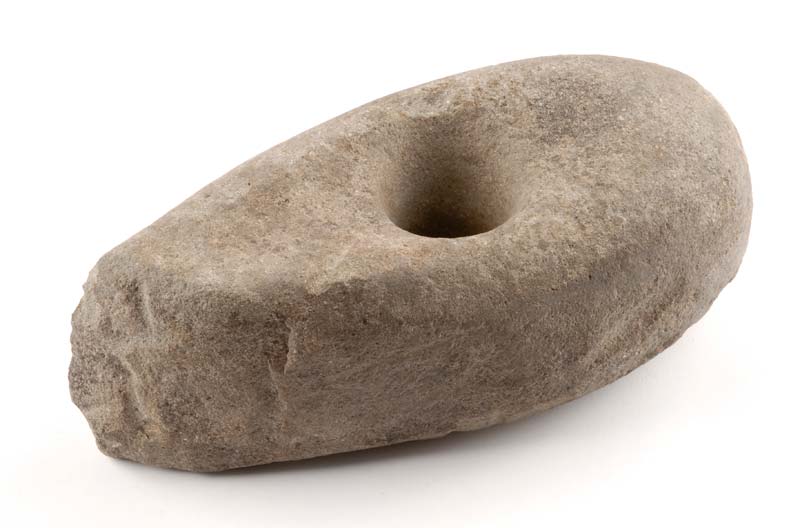
Kat, Curator of Archaeology, recently made these fantastic axe hammer cakes for our #MusCake escapades. They were dark chocolate and orange – as you’ll see, basically interpreting the Bronze Age through the medium of the Jaffa Cake.

The axe hammers that Kat modelled her cakes on date from the Bronze Age (2500-1500 BC). The example below comes from Wike, near Leeds. The axe hammer head is teardrop shaped and is made from sandstone.


What is amazing, is that we just don’t know if the term ‘axe hammer head’ is even correct. Some studies have shown that if the hole was used as a socket for a handle, the head would still be too heavy to be lifted and swung. They may have been used as a steadying tool for holding something in position.

More recent interpretations suggest that they might have had a ritual use. I (personally) like the idea of the hole being an area that you might look through! It’s all about interpretation… 


Another example from our collections (see right) was found near Morley, purely by chance! It’s on display in the Leeds Story Gallery at Leeds City Museum.

Keep your eyes peeled – you don’t know what you might find!

By Curator Lucy Moore


Monday, 13 January 2014

My archaeology placement year at Leeds Museums and Galleries

As part of my course at Bradford University, where I am studying for a BA in Archaeology, I had the option for my third year of undertaking a placement year.
During the first two years of my course I had discovered that museum work could be an avenue under the umbrella of archaeology that I may wish to pursue. I was therefore very interested to be part of a museum environment for my placement, so I went about securing several interviews with museums in the West Yorkshire area. I was lucky enough to obtain a placement position at Leeds Museums and Galleries. Lucy Moore (cover Archaeology Curator for Kat Baxter) came to meet me at the University for an interview and was fantastic and I greatly appreciate all her help.  
On arriving at The Discovery Centre (the Museum’s store facility) on my first day back in mid-September, the first task given to me by my supervisor and Archaeology Curator, Kat Baxter, was to get to work accessioning the M1-A1 Link Road Excavation archive. I wrote down every box name, their location and contents.
Going through the excavation archive
I then went through the publication of the excavation, ‘A New Link to the Past: The Archaeological Landscape of the M1-A1 Link Road’, where a previous volunteer had started accessioning the small finds. I first found all those objects, inked on their accession numbers (using special archival ink), photographed them – front and back, then filled in the relevant information onto the museum database, TMS. Some of the objects included an iron knife, a ring, flints and querns.
Bronze Age jet disc from the excavation, accession no. LEEDM.D.2008.3.39
I was then fortunate enough to spend four weeks at Leeds City Museum as a Visitor Assistant, which was such a good experience as I was able to see how different aspects of the museum work.  For example, I gained an appreciation of the difference between the day to day work of a Curator compared to the day to day work of a VA which was very interesting. My role as a VA was to patrol the galleries assisting members of the public when necessary, working in the museum shop and setting up for conferences. My highlight though was definitely Halloween half term, as I got to help out with craft activities in the education room, which was a hive of activity.
I then returned to The Discovery Centre where I carried on with the M1-A1 Link Road Excavation archive.  I moved on to the objects in the archive which weren’t accessioned, which included all the pottery pieces, more flints and querns. I accessioned these objects, photographed them then filled in the relevant information into TMS, including the period, description, location, constituent and dimensions, which I gathered from the excavation publication.

Accessioning flints from the excavation

And now here I am, it’s already 2014!  I have just completed the archive, so Kat has informed me what my next task will be: to co-ordinate a new archaeology display case at The Discovery Centre with the archaeology volunteers and interns. I am very excited about this as it is such an invaluable opportunity and a fantastic experience.
By Laura Bradbeer, BA (Hons) Archaeology student at Bradford University, and placement student at Leeds Museums and Galleries 


Thursday, 12 December 2013

"Oh Christmas tree, Oh Christmas tree" - themed trees at Leeds City Museum

In the spirit of the festive season, 20 fabulous Christmas trees of different sizes have gone up around Leeds City Museum.  But these aren’t ordinary Christmas trees - they’ve each been decorated by members of staff and volunteers to represent Leeds Museums collections, historic sites, and the city of Leeds itself.  Yes they’re home-made and often the quality of the baubles is questionable (mainly the archaeology ones), but what a great way to celebrate all things LEEDS! 
So here’s a sneak preview of what you might see if you visit Leeds City Museum between now and 6th January…


Celebrating the coin collection

Pom poms and sailing boats

Baubles on the archaeology collection tree

                                                   
Some of the tree-toppers are particularly inspirational.  A gold Anglo-Saxon ring pierced by a Neolithic arrow tops the archaeology tree.  Other top toppers include Armley Mills waterwheel and the famous Leeds antiquarian Ralph Thoresby, clearly having an amazing time.


But some trees also have a serious message.  This tree in the Life on Earth gallery represents the plight of the worlds oceans:


Festive greetings from the (not so happy) sea. 
See all of these Christmas trees and many more around Leeds City Museum until 6th January.  Merry Christmas!


Katherine Baxter
Curator of Archaeology
Leeds Museums and Galleries


Friday, 6 December 2013

Excavation stories: A knuckle guard from Kirkstall Abbey Guest House

Research is currently underway on West Yorkshire Archaeology’s excavations of Kirkstall Abbey Guest House, conducted between 1979-1986. The publication will examine the various structures of the Guest House complex, and through the medium of the artefacts, look at the range of activities carried out within the buildings and the types of visitors and residents who used the facilities. As part of this work, the assemblage of artefacts recovered is being reviewed and catalogues up-dated.

ABOVE: The standing remains of Kirkstall Abbey Guest House complex.

Just one of the 11,425+ objects is mentioned here, to give an idea of the information that can be gained. Small Find no. 3244 is thought to be a finger-joint cover or knuckle guard from plate armour gauntlets. During the 13th century armoured protection for hands was provided by mail mufflers (Edge and Paddock 1988, 81), but from c. 1330-40 hour-glass-shaped metal gauntlets were developed. These gauntlets comprised a plate protecting and shaped to the side and back of the hand, narrowing to the wrist and then opening out to form a short cuff (Griffiths 1990, 1084). The fingers of the wearer were covered with two narrow metal plates, placed either side of the knuckle and riveted to an internal cloth or leather glove. The knuckles or joints of the wearer’s fingers were protected by curved plates like no. 3244, which over-lapped the finger plates, allowing complete flexing of the hand. These knuckle or finger-joint covers were attached to the leather via the rivet holes on either side. 
ABOVE: Finger joint covers or knuckle guards.  Left: from Kirkstall Abbey Guest House (c) Archaeological Services WYAS.  Right: from Coppergate, York (c) York Archaeological Trust. 


The finger-joint cover or knuckle guard from Kirkstall is damaged and the rivets missing, but the lack of iron corrosion suggests that slender copper alloy rivets were originally used, indicating a date in the second half of the 14th century (Ottaway and Rogers 2002, 2970). Similar finger-joint covers or knuckle guards have been found at excavations at Coppergate in York (Ottaway and Rogers 2002, 2969-70) and at Winchester (Griffiths 1990, 1084). The Kirkstall example is narrower than the examples mentioned and may possibly have protected the pinkie joint.

Hour-glass-shaped metal gauntlets can be seen on brasses (e.g. Sir John Harsick, Southacre (Norfolk), d.1384; William de Aldeburgh, at Aldborough (Yorks.) d. c. 1360) and are depicted on the St William window at York Minister (Griffiths 1990, 1084 and fig.139; Ottaway and Rogers 2002, fig. 1534).

ABOVE: Detail from panel 1b of St.William window, York Minster, showing metal gauntlets being worn.

Kirkstall Abbey Guest House was not for ordinary wayfarers, but a residence for visitors of rank and wealth to the Abbey, as the gauntlet finger-joint cover nicely illustrates.

  
Bibliography
Edge, D. and Paddock, J. M, 1988 Arms and Armour of the Medieval Knight (London)

Griffiths, N. 1990 ‘Finger-Joint Cover from a plate armour gauntlet’ in Biddle, M. Object and Economy in Medieval Winchester (vol.2), 1084-5

Ottaway, P. and Rogers, N. 2002 Craft, Industry and Everyday Life: Finds from Medieval York The Archaeology of York: The Small Finds 17/15


Author: Holly Duncan, Project Manager (Artefacts) at Albion Archaeology


Thursday, 10 October 2013

Why we love researchers! New exciting information on an Egyptian stela fragment

A fragment of Egyptian carved stela in the Leeds Museums and Galleries archaeology collection (LEEDM.D.1960.81) has been on display in Leeds City Museum since it opened in 2008.  It is a wonderful object depicting kilted figures and hieroglyphs, but up until last week I could say very little about its origins or what the original inscribed stone was for.
But all that changed last week with one email.
The stela fragment in question, on display in Leeds City Museum
(c) Leeds Museums and Galleries

A researcher called Alexander Ilin-Tomich contacted me from the Institute of Oriental Studies in Moscow to ask if I could send him a picture of ‘an Egyptian Middle Kingdom stela’ in our collection, which has only been mentioned once in academic literature: in Malek Jaromir’s 2007 volume ‘Topographical bibliography of ancient Egyptian hieroglyphic texts, reliefs, and paintings VIII: objects of provenance not known’.  I narrowed the options down and estimated that it must be this object LEEDM.D.1960.81.  Alexander confirmed it from the photograph,  and was then was able to tell me lots of information about this one fragment from his own research on Egyptian private memorial monuments.  We now know that: 
  • It is the lower left part of a memorial stela, so a stone for the deceased.  It was probably produced in Thebes, or perhaps Abydos, during late Dynasty 13 to Dynasty 16 (18th – 17th centuries BC).
  • The upper row of the fragment would have probably represented the owner of the stela. The chair leg that is still visible would have seated his wife.
  • The figures depicted at the bottom, making up the most of the surviving fragment, would be the owner’s dependents, colleagues or friends.  The two men on the right are military officials; the hieroglyphs beside them read “[commander] of the ruler’s crew Sebekhotep” and “commander of the ruler’s crew Antef”.
Alexander also sent me images of complete memorial stelae , which give an idea of the possible original layout of this object before it was broken.  This is all fantastic information which we would never have found out otherwise.
Image of an almost complete memorial stela in Moscow, provided by Alexander Ilin-Tomich
(c) The Pushkin State Museum of Fine Arts
This is why working with researchers is so vital to us in museums.  We provide the links between researchers and collections, and they share with us their knowledge and research results, which we then use to engage our audiences.  Now I can change the label in Leeds City Museum and interpret this object more fully, and update all of our records.  What was once an unidentified Egyptian stone fragment will now be brought to life.

Katherine Baxter
Curator of Archaeology
Leeds Museums and Galleries


Friday, 6 September 2013

Collections through Cake: Kirkstall Abbey's Chocolate Floor Tiles

The most recent Collections through Cake was brought to you by Kat, Curator of Archaeology. One of Leeds Museums nine sites is the beautiful ruin of Kirkstall Abbey, a former Cistercian monastery. Incidentally, Kirstall Abbey has been shortlisted in the 'Britain’s favourite heritage site' category in the BBC Countryfile Magazine Awards 2013. Full details can be found on BBC Countryfile Magazine’s website at www.countryfile.com/awardsvote, or you can email your votes to awards@countryfile.com.


But back to cake ... Apart from the Abbey itself we have amazing collections from excavations that have taken place. Some of the most charming objects are these beautiful floor tiles: And what would make a medieval floor tile even more exciting? If its made of brownie and decorated in gold and silver!

To see previous Museum Cakes, go to Twitter and follow #MusCake, or have a browse through our posts below!


Wednesday, 31 July 2013

Dawn Stones

As a curator new to the collections at Leeds Museum Discovery Centre, sometimes enquiries lead me to parts of the collection that I didn't know were there, to look at objects I know very little about. A recent enquiry was whether we had any eoliths in our collection.

Eoliths were identified in the nineteenth century as pieces of chipped flint that had been worked by humans. They were used as part of a debate to 'prove' that humans were living in what is now Britain in the Plesistocene era 1.8 million years ago. They were seen as a missing link in tool lineage - simple tools that gave a 'descent' to more complex stone tools such as handaxes. The name eolith translates as 'dawn stone'. They fed into a broader debate between English and French experts as to where 'early man' lived first, inferring it was to be hoped an English supremacy.

Today, many see eoliths as geological debris, formed by water movement and glaciation.

My experience with eoliths was quite limited, I'd read about them, but hadn't really thought about them. So I thought I would share our compact eolith collection and my findings with you. They fall into four provenances. The largest group come from Kent. Then there are four from France. Single examples come from Aldborough and Cromer.

Cromer Eolith

The Kent eoliths are particularly interesting as they belonged to the collection of Benjamin Harrison (1837 - 1921) who championed eoliths as evidence of human tool-making. He lived in Ightham and found many of his examples across the South Downs. Harrision was instrumental in deriving a classification for the eoliths. The classification he produced was dependent on presumed function of the 'tool'.

It is this process of classification that is so fascinating today.
A selection of Leeds Museums' eoliths are currently on loan to the Henry Moore Institute, Leeds, for their new exhibition Indifferent Matter: From Object to Sculpture.


Other inspiring blogs about eoliths come from Manchester Museum include: "Is it a bird?" and "Every Rock is a River". Eoliths are seen as tools by some still today. A really interesting project has been undertaken at Kent University about the controversy of eoliths. What do you think?


Thursday, 4 April 2013

A Romano-British Head Pot

Imagine my surprise when, whilst sorting through a box of Romano-British pottery sherds from Leeds Museums and Galleries collections, I found this handsome face staring (well, perhaps staring isn’t quite the right word) up at me!

This object (LEEDM.D.1966.0083), probably excavated from the Roman town of Aldborough in North Yorkshire, is a ceramic fragment which has been moulded in the form of a male face. You can distinctly see his nose, pursed lips, left cheek and a section of chin. This sherd would appear to originate from an elaborately decorated vessel - was I looking at the Roman equivalent of a Toby Jug?!


Vessels with faces on them seem to have been popular throughout the Roman Empire. The most common type are face pots, which were probably introduced to the province of Britannia by the Roman army during the first century AD, as early examples are found primarily at military sites. However, being seemingly fashionable and popular, this style of vessel soon spread throughout the province. The portraits on these however are much more schematic, and indeed more comedic, than our example.

A pair of typical Romano-British face pots, these examples were found in London (Braithwaite 1984: 109, fig. 6).

The more naturalistic, Classical features of our face suggest it originates from a different type of vessel, probably a small head pot. Similar faces are also found on Late Roman head-neck flagons (where a small moulded head is applied to the neck of the vessel), but I think our example is slightly too large for this.

Head pots consist of a moulded human head which forms the body of the vessel. They seem to be an insular British occurrence, developing quite independently from their distant cousin the face pot, and became fashionable in the early third century AD. They were made locally but influenced by the exotic cultures and styles of the Eastern Mediterranean. They are uniquely found on our island and their distribution is further confined to the east of the country, north of the Thames.


A selection of Romano-British head pots, these were found at York, Piercebridge and Chester-le-Street (Braithwaite 1984: 118, fig. 11).

The jury is still out regarding the function and use of these vessels. Although many examples lack context, the majority of provenanced head pots come from ritual sites, but a few have cropped up on domestic ones too. They are probably linked to some form of ritual or cult – but which, we do not know. One head pot found at Lincoln bore the painted inscription DON MERCVRIO – ‘To the God Mercury’ – but no other vessels have been found so usefully labelled. Compared to face pots which are usually coarse cooking ware, head pots are relatively fine. Perhaps they held liquids rather than food, such as wine for libations and offerings.

So what role did the faces play in all this? Did they have an important ritualistic function, or are they purely decorative? Whilst some similarities have been found between faces on different pots, the majority of portraits vary greatly, suggesting them not to be associated with one particular deity or cultic figure. Is the face depicted on our vessel that of a specific individual, a deity or just a generic portrait? Such objects pose interesting, and indeed frustrating, questions and serve as a reminder of how some aspects of the past still remain elusive to us.

Interested in reading more about these fascinating Romano-British vessels? This article provides an excellent overview of the subject: Braithwaite, G. (1984) ‘Romano-British Face Pots and Head Pots’, Britannia 15, pp. 99 – 131.

Lucy Creighton


Thursday, 14 February 2013

Love is in the Air!

It's Valentine's Day and we're feeling heart-y in the archaeology and numismatics department. A recent acquisition is this beautiful seventeenth century bleeding heart seal.


One of a number of post-medieval seals discovered by metal-detectorists and recorded by the Portable Antiquities Scheme, Leeds Museums were able to acquire the seal through generous donations. It shows a heart with an arrow through it with four drops of blood below. In addition it has the inscription “thy uertu merits more” (Your Virtue Merits More).


Usually seen as an amatory token, several of these have been found and recorded through the PAS. Ours is special because it still has the delicate hinge that held the seal and its back piece together and is particularly finely made. However, the seal may be much more than a love token. There has been recent debate as to whether these seals may have had a religious rather than a romantic significance. Some interpretations relate its symbolism to that of the Christian Sacred Heart which alludes to Christ's death and the transformative power of divine love. Regardless of which interpretation you agree with, I'm sure you'll agree it is a beautiful addition to the collections here in Leeds.

Happy Valentine's Day!