Showing posts with label Costume and Textiles. Show all posts

Wednesday, 22 June 2016

The Leeds tailors who dressed the 1966 England football team


Football fever has once again taken over the country (or so the media would have us believe anyway). Three of the home nations have been competing in Euro 2016 and next month we will celebrate the 50th anniversary of arguably one of the greatest moments in English football: winning the 1966 World Cup.

One of the key photo opportunities during any major football championship is the team photo with all the players in their team suits. For the 1966 tournament the team suit was made by the Leeds tailoring company Burtons, who promoted themselves as 'the tailor of taste'.

1966 was an exciting year for Burtons, as not only were Burtons suits worn by sporting royalty but actual royalty came to Leeds! Princess Margaret received a tour of the Burtons Hudson Road factory.


Burton 1966 Brown piece dyed Glen check two piece suit
Burtons brown piece dyed Glen check two piece suit, 1966

Leeds has been known for its textile industry since before the Industrial Revolution and, although there was a gradual decrease in the second half of the last century, clothing manufactures still remain in the city today. Burtons began life in 1903 and was named after its founder Montague Burton. Although the company had offices in Sheffield the main hub of the company was its Hudson Road factory in the Burmantofts area of Leeds.

Aerial View of Burton Hudson Road Factory, Burmantofts, Leeds
Burton Hudson Road Factory, Burmantofts, Leeds.
(Image: Yorkshire Post Newspaper Ltd.)

Brian Rayner spent 52 years working in the clothing industry. He began his career at Burtons Montague in 1960, when he was 15 years old. In 2012 he gave an oral history interview to Leeds Museums about his time in the textile industry. Brian's history offers an amazing insight into clothing manufacturing and the changes in fashion, manufacturing techniques and the gradual move from bespoke tailoring to more ready to wear suits over the years.

The Cutting Room at Hudson Road - 1960s
(Image: Yorkshire Post Newspaper Ltd.)

What really struck me when I listened to Brian speak was the picture he painted of the social aspects of working for Burtons and the sheer size of the Hudson Road factory. There were 10,000 people working at the factory and the site included a canteen which could seat half the workforce in one siting. 

Brian described how the tea ladies came round with tea and sandwiches at 10 o'clock in the morning and took your lunch order (for which there were 3 choices ranging from 11 pence to one shilling and 3 pence). When you took your meal ticket along at one o'clock your lunch would be waiting for you. 

Inside the huge canteen at Hudson Road - 1960s
Inside the huge canteen in a Burtons factory - 1960s
(Image: Yorkshire Post Newspaper Ltd.)

If you needed to burn off that lunch there were on site sporting facilities. Brian remembers two football pitches, a cricket pitch with athletics track round the outside, a rugby pitch, a bowling green, a putting green, tennis courts and snooker tables. Phew...it makes me feel tired writing the list let alone using the facilities!

Burtons workers enjoying the sports facilities at Hudson Road - 1960s
(Image: Yorkshire Post Newspaper Ltd.)

There were not only leisure and catering facilities on site but also free health care. As well as having a fully equipped nurses station, Burtons offered free dentistry, chiropody and free hairdressing for the ladies of the factory, of which there were many! Nearly all the sewing machinists were female compared to the predominantly male hand-tailoring and press room sections. Brian remembers the work force consisting of 1 man for every 10 women.

Burton workers clocking out of work - 1960s
Burtons workers clocking out of work - 1960s
(Image: Yorkshire Post Newspaper Ltd.)


This was not the only gender imbalance at the factory, as there was also a disparity in the pay – although perhaps not what you might expect! Brian remembers being paid £3 and 15 shillings a week when he first started working as an apprentice. In comparison the women who were fully trained in the sewing room were being paid £8 per week. 

Nevertheless, Brian says, if you took a female colleague out to the pictures the man was expected to pay! Brian also had to hand his wages over to his mother. She would take out what she needed for board before giving the rest back to him. 

Burton staff outing to Morecambe - 1960s
Burtons staff outing to Morecambe - 1960s
(Image: Yorkshire Post Newspaper Ltd.)

Walking into the huge Hudson Road factory with its 10,000 staff - 500 employed solely for cutting the fabric – 5000-seater canteen, social opportunities and sports facilities not forgetting a 10:1 female to male ratio must have been an amazing sight for a 15-year-old boy starting his first job.

Sources: Montague Burton: The Tailor of Taste (1990, Manchester University Press).


By Rebecca Fallas, Volunteer Blogger


Discover more:

You can see more on Burtons and the 1966 England suit, including an interview with Brain at the Leeds Discovery Centre on Living in '66 - Suits, Boots and Northern Roots. The programme is available on BBC IPlayer until 1st July 2016.

If you'd like to take a tour around the Discovery Centre store like Kay Mellor in Living in '66, our store tours take place every Thursday at 11am and 2pm. Visit the Leeds Museums and Galleries website for more details.

If you'd like to learn more about the textile industry in Leeds why not visit Leeds Industrial Museum or Thwaite Mills?


Thursday, 19 February 2015

A Tale of 1,001 Fabrics - the Hepworths Collection


Gentlemen of a certain age (OK, then, over 50) are more than likely to have owned a suit which was made in Leeds, once the capital of the British clothing industry. Leeds boasted many clothing manufacturers, large and small, including the likes of Sumrie, Browns, Berwin & Berwin, John Collier, the Fifty Shilling Tailor, Burtons and Hepworths.

Burton’s factory in Harehills was the largest of its kind in the world, boasting the world’s largest sewing room, photographs of which are still awe inspiring. Hepworths, founded in Leeds in 1864 and now transformed into Next plc, was famous for many reasons, including its monstrous HQ building on Claypit Lane and the first association of a famous designer (in this case, Hardy Amies) with a High Street tailor/retailer.  In the battle of one-upmanship, Amies was a trump card.


Inside the Burton's Factory sewing room.

Hepworths is part of Leeds’ heritage and, not unnaturally, Leeds City Museums and the magnificent Discovery Centre have lots of Hepworth-based material. These include the in-house newspaper, the ‘Hepworth Mercury’, which printed news about employees and about the company itself. Did you know that Hepworths provided uniforms for all sorts of groups, including Olympic athletes and Leeds Rugby League football club?

Volunteering with the Textiles collection

Several of my relatives worked in the Leeds clothing industry, so textiles must be in my genes (and jeans).  It seemed natural that my working life should relate to the industry and I ended up as head of the Textile department at Huddersfield University. When I retired, I looked at doing some voluntary work in order to make use of whatever expertise I have. So, I arrived at Leeds Discovery Centre under the tender care of Natalie Raw, Curator of Textiles and Fashion, and have been involved in digitising parts of the clothing collection ever since, from 18th century women’s dresses to 20th century men’s waistcoats.

So when Natalie mentioned that there was a box of Hepworths menswear fabric swatches to look at, dating from the 1960s/70s, I jumped at the chance. These have been sent to Armley Mills Industrial Museum for visitors literally to get a feel for Leeds made fabrics. The rest are in my gentle hands being catalogued.


My textile design students at Huddersfield came up with weird and wonderful colour combinations, but even they would be amazed at what I have come across. There are fabrics the colours of which don’t so much shout at you but yell at the tops of their voices. Some are absolutely hideous (to a 2014 fashionista like me!) but must have had some sort of market then. Some are beautifully subtle (how did they sneak in?).

There are the top of the range fabrics (Golden Heritage, usually pure wool) and the ‘bog standard’ range, often containing polyester.  Some of the fabrics might even be in vogue today (although for men much younger than me): the bright red jacketing and bright yellow trousering would certainly appeal to some.  Overall, it provides a fascinating review of a bygone age and an endless source of inspiration for me.


Discover more about Leeds tailoring

If Leeds tailoring is your thing, do visit the magnificent tailoring gallery at Armley Mills, which is about the history of Leeds tailoring. And if you like delving, exploring and being amazed, join the army of volunteers at the Discovery Centre (Find out how to volunteer for Leeds Museums and Galleries)!

By John Pearson, Dress and Textiles Volunteer


Thursday, 22 January 2015

New Display of Korean Fashion at Leeds Museum Discovery Centre

Voices of Asia intern Myunghae Seo created this Korean costume display
at Leeds Discovery Centre.

As a Korean living in the UK it has been amazing to engage with the Korean costume collections here in Leeds during my internship and select seven items for this new display. 


High class traditional Korean dress or hanbok continues to follow designs developed over the past 1600 years. The Fan Dance doll (pictured above) shows us a complete costume, while the finely embroidered shoes are a good example of contrasting colours, and the fur trimmed hood is typical winter wear.

Traditional Korean wedding costume
These days, Koreans only wear hanbok for special occasions such as weddings (pictured right), funerals and first birthdays, but it was worn daily up until 100 years ago. 

Hanbok are created beautifully through combinations of colours and curved lines. Women’s hanbok in particular are composed of short jackets and full skirts, which make the upper body look small and the lower body look full, creating an attractive balance.

Personally, I really like wearing hanbok because of its delicate colour and patterns, though when you are not used to it, it can be a little uncomfortable. 

The History of Hanbok
Hanbok developed during the Joseon Dynasty (1392-1897), which was built upon Confucianism. This philosophy and faith permeated the whole of South Korean society, including people’s behaviours and lifestyles. The ideal woman was believed to be pure, obedient and faithful. They were supposed to be completely hidden from the outer world and obey their fathers, husbands and sons. 

Only upper class women were allowed to wear a variety of colours and patterns and only the royal family could use geumbak, or gold printed patterns, on their bottom of skirt. A navy colour worn on a woman’s blouse cuffs indicated that she had son(s). Upper class women were meant to act demurely and partly hide their face. (Watch this You Tube video by Korea Today for an overall idea of hanbok.)

Embroidered hanbok bag from the
Leeds Museums and Galleries collections.

What is it like to wear hanbok?
I vividly remember dressing up in hanbok and carrying a little bag like this with me on Korean New Year’s holiday, Seollal, when I was little. After the family meal on that day, the younger generation would pay their respects to their elders by taking a deep bow called sebae, and the elders would offer their blessings and wishes for the New Year. 

Children would receive sebatdon (New Year’s money) as a gift. Right after I received the money from my grand-parents, uncles and aunts, I put it into my bag, and then when they left, I counted the money in my room, and hid it in a secret place. All the money was for my sweet treats for the year and I wanted to keep it secret from my mother. 

Embroidered hanbok bags
These small traditional bags (pictured above) have various patterns which are believed to bring fortune and luck. As hanbok does not have separate pockets, their purpose was to carry money, goods or a perfume box. Many of these bags are embroidered with flowers and animal patterns, and with gold and silver Chinese characters, and are gathered shut by silk cords with large tassels.

Find out more:
To learn more about hanbok, see Hanbok: Timeless Fashion Tradition by Samuel Songhoon Lee, Korean Textiles and Costumes of the Choson Dynasty by Claire Roberts and Huh Dong-Hwa, or Hanbok – The Art of Korean Clothing by Sunny Yang, both published in 1998​.

By Myunghae Seo, 'Voices of Asia' Intern


Thursday, 21 August 2014

Well Suited: The First Male Models

George Rutland riding a penny farthing on the street
in 1964 
(Hepworth Mercury Archive)

Do models care about what they wear? According to George Rutland, one of Britain’s first top male models, they absolutely do! 

From penny farthing-riding plus fours to groovy wide-leg flares with high-heeled boots to a canary yellow-coloured suit, Rutland had the opportunity to wear a wonderful array of fashionable clothing during his modelling career in the 1960s and ‘70s. 

In a recent interview, conducted as part of a research project exploring the fashion industry in Leeds during the post-war period, the Bermuda-native confirmed that models do indeed take an active interest in the pieces they showcase on the runway. Rutland reminisces how he swelled with pride when walking down the catwalk in a meticulously-tailored suit and firmly believes that a man never looks or feels better than when he is wearing a classic suit.

Group of models (Hepworth Mercury Archive)

Although he initially came to England from Bermuda as an aspiring actor, Rutland began modelling for Hepworths, a Leeds-based clothing manufacturer, shortly before the company’s centenary in 1962. As part of their fee, professional models received the suits they had worn the previous season when they attended their annual fittings, so Rutland amassed quite a sizeable wardrobe, including many bespoke suits created by Savile Row designer Hardy Amies. 

Rutland was so pleased with the quality of these suits that he wore them every day, not just on the runway. He was happily ‘plugging Hepworths the whole time’. This commitment to maintaining an impeccable, suited appearance proved highly beneficial for Rutland, as his Hardy Amies Hepworth’s suit won him a film role and earned the approval of esteemed photographer Sir Cecil Beaton. Rutland tells the story in his own words here.

A very stylish man: Tony Armstrong-Barnes

Tony Armstrong-Barnes, Rutland’s fellow model and close friend, received similar attention when wearing Hardy Amies’ suits. Upon encountering photographers and tailoring company executives around town, Barnes was often recognised and complimented for his stylish apparel. He fondly recalls the time that television producer Monty Berman saw him at the opera and complimented the young model’s ability to wear a suit. Listen to Barnes recount this moment here.


Unlike Rutland, who later became a fashion show director, Barnes devoted himself to professional modelling and worked for a number of companies, including Hepworths, Burtons, Alexandre and Marks & Spencer. Originally an aspiring dancer, who compares his childhood dreams to those of Billy Elliot, Barnes unexpectedly began modelling in the late 1950s after standing in for an ill friend at a photo shoot for a knitting pattern cover. 

Tony Armstrong-Barnes, 1965
(Hepworth Mercury Archive)
Due to the lack of young male models during this period, as well as his good looks and charm, Barnes quickly became sought-after by prominent London photographic studios and developed a large portfolio. Some of his most significant jobs included a Kellogg’s Corn Flakes box advertisement with Patty Boyd (a famous model who later married both George Harrison and Eric Clapton) and Burton’s 1964 photo ad (the first colour advertisement in an English newspaper). 

Since models of the era were responsible for providing their own accessories and styling themselves at photo shoots, Barnes acquired a vast wardrobe consisting chiefly of suits, which he wore in his leisure time as well as to work. Indeed, he was so accustomed to donning formalwear on a daily basis that he even wore a pinstripe suit for his first meeting with photographer David Bailey, who is best known for capturing casual images. Barnes briefly describes this meeting here.

Due to changing fashions throughout his career, Barnes had the opportunity to wear a diverse variety of styles, ranging from the velvet suits of the Teddy Boys to the narrow trousers of Mods. Perhaps since he was expected to appear in contemporary fashions on the runway, Barnes preferred to imitate the classic, tailored style of actors like Cary Grant and George Pepard when selecting his private wardrobe. In contrast, his friend Rutland always embraced the latest trends and relished wearing flares and platforms in the 1970s. Rutland still laughs when he recalls tripping in a particularly expensive pair of trendy, high-heeled boots. Listen to this amusing anecdote here.

After more than 50 years in the fashion industry, both Rutland and Barnes continue to maintain substantial wardrobes that include starched cuffs, neckties, and waistcoats and, of course, high-quality suits. After all, as Rutland confirms, ‘You can’t get away from a classic man’s suit.’ Leeds Museums are fortunate to have several such fine suits in their collections, some of which will be on display in the newly re-developed tailoring gallery at Armley Mills.

By Curatorial Intern Katherine Young


(Images: Hepworth Mercury Archive)


Friday, 4 July 2014

Jewish textiles in Leeds

Hannah Bloom kindly showed me several textile artworks at the Sinai Synagogue yesterday. They include pieces on Sukkot and Jerusalem done several years ago under the direction of artist Gillian Holding, in the main Prayer Hall, and more recent pieces on the history of the synagogue, including one made this year for this Reform synagogue’s 70th birthday.

In the stairway down to the children’s area there is also a multi-panel embroidery of the Hebrew alphabet. Many people have come together to work on these embroideries and their quality and vibrancy make them ideal as possible loans for any future Jewish exhibition.

Hannah  made the figure of the young girl in this family standing under the Sukkot temporary roof canopy, a feature of this harvest festival celebration.

Embroidery  by Hannah Bloom

It’s interesting to compare these modern embroideries, such as this Hebrew letter (also by Hannah) done on a patchwork background from fabric fragments saved from the making of Joseph’s coat  worn in a production of Joseph & The Amazing Technicolour Dreamcoat, to the older embroidered details on Torah mantles, and prayer shawl bags that we have in the museum collections. These are mainly from the United Hebrew Congregation in Leeds, and came to us via the Manchester Jewish Museum in 1990.


Some of the older embroideries were done by professional firms, probably based in London, such as the green Torah mantle above), but others look more home-made, such as the red velvet Torah mantle (above) with its many sequins and the Star of David.

By World Cultures Curator Antonia Lovelace


Tuesday, 17 June 2014

Hats Off to Royal Ascot

Hat created by designer David Shilling, 1980s
It is that time of year again when fashion and sport collide at one of the most popular and colourful events in the British summer season – Royal Ascot. It truly is an event which sees people making an effort to get dressed up. The dress code at Royal Ascot requires all women to wear hats and all men, in the most prestigious Royal Enclosure, having to wear morning dress, including a top hat. Traditionally the third day of Royal Ascot, known as ‘Ladies Day’ is when race-goers really make a statement with the most flamboyant fashions, especially hats.

The Leeds’ dress and textile collection has lots of fantastic hats, including some amazing ones by top British milliners who will, in no doubt, have many of their creations on show at Ascot, this year. From the 1980s we have a hat by David Shilling (born 1956). His name has become synonymous with Royal Ascot, since he made his name designing and creating hats, from the age of 12, for his mother Gertrude to wear at Ascot. Although he did not have any formal millinery training his extravagant hats were an instant success.

Philip Treacy hat (purchased with help from the V&A
Purchase Grant, Leeds Art Fund, and Friends of Leeds Museums)

Another amazing hat is this one off couture hat commissioned by Leeds Museums and Galleries from the internationally acclaimed designer Philip Treacy (born 1967), in 2009 (purchased with help from the V&A Purchase Grant, Leeds Art Fund, and Friends of Leeds Museums).  The hat has a small central disk with knot design, from which radiate out antique bird of paradise feathers that give an overall delicate, smoky effect. The hat is currently on display in the Leeds Gallery at the City Museum.

 Smaller headpieces and fascinators have become increasingly popular recently. At Royal Ascot however, the organisers felt they needed to stave off this fashion and maintain a ‘proper’ hat dress code. In the Royal Enclosure it is now stated that a hat or headpiece with a disk of over 10cm in diameter has to worn.

This Philip Treacy hat is just about big enough and so would be allowed in the in the Royal Enclosure.

By Costume and Textiles Curator Natalie Raw​


Thursday, 15 May 2014

The Tale of a Bill Gibb Dress

‘Be a latter day Infanta, in charted gold satin… be a frill…’ British Vogue, October 1st 1971
I have spent the past few months rifling through hundreds of beautiful clothes held in the Leeds Discovery Centre (and all under the watchful eye of a taxidermy chimpanzee!) From 17th Century undergarments to Burberry trench-coats it is a treasure trove of textiles that contains three centuries worth of classic pieces.

After sorting around 300 garments into chronological order I came across one of the most bizarre dresses I have ever seen. Dated 1976, full length, gold, black, red, and covered in print, applique and embroidery I thought had been labelled wrongly as its style was at odds with the low cut, puffy sleeved, brown and yellow dresses that made up the rest of the cupboard.


Dress designed by Bill Gibb for his 1976/1977 Winter collection

The dress was labelled Bill Gibb and I had to find out more about it.It is in fact, not a dress, but an ensemble made up of a skirt, tabard, and kaftan. The eclectic and contrasting layers make it a completely unique piece, and almost like a Sari. The kaftan has a large bee printed on it, as the bee was a marker of Gibb’s work, and often appeared on the buttons of his dresses. 

Alongside the bee are multi-coloured pansies printed underneath a layer of sheer sequins. The dress was created for Bill Gibb’s 1976/1977 Winter collection and was first shown in the spring on that year. It was previously displayed at Lotherton Hall (which is currently developing an exciting new area dedicated to its fashion and textile collection) and is stained with lipstick and makeup from its debut catwalk show, which I believe adds more character.

Who was Bill Gibb?

Bill Gibb was from Fraserburgh, Scotland. At an early age he showed a great aptitude for art and was encouraged to study it by his teachers. He later moved to London, where he studied at Saint Martins and finished first in his class, and after graduating he was taught by Janey Ironside at the Royal College of Art. 

He designed clothes for Baccarat, and in 1970 one of his designs for Baccarat was named dress of the year by British Vogue. There was even a room dedicated solely to his work in Harrods department store. After establishing his own brand Bill Gibb Ltd in 1972 alongside his partner Kaffe Fassett and business partner Kate Franklin his work became eponymous with the British Boutique Movement, which also included designers such as Ossie Clark and Jean Muir. 

Although the Pre-Raphaelite and Bohemian styles were popular with other designers of the seventies his work stood out due to his Eastern and Celtic influences, and outlandish prints. In 1971 he dressed Twiggy for the premiere of Ken Russell’s film The Boyfriend, which soared him to fame. His designs were also very popular with Bianca Jagger and Elizabeth Taylor. In 1974 he launched a knitwear collection, and in 1975 opened up a shop.

Unfortunately his company was in financial ruin and he is now one of the less referenced designers of the time due to his untimely death in 1988. Only three retrospectives have been held of his work. The first was ‘The Golden Boy of British Fashion’ at the Aberdeen Art Gallery and Museum (which holds the largest collection of his work in the world) in 2003, and the second and third in 2009 at ‘Bill Gibb- A Personal Journey’ at the Costume Museum in Bath and ‘Billy: Bill Gibb’s Moment in Time’ at the Fashion and Textile Museum in London. 

However, his legacy lives on as his clothes have inspired the works of contemporary designers such as John Galliano and Giles Deacon.

By Billie McKenzie, Dress and Textiles Intern


Friday, 14 December 2012

An evening dress by Norman Hartnell

Last time I wrote about festive party frocks of early 20th century, and promised to continue on the subject. Recently I came across a lovely evening dress from 1930s, designed by Norman Hartnell, and I just had to write about it.


Norman Hartnell (1901-1979) was one of the most prominent British designers of the 20th century, and also dressmaker for Queen Mary, Queen Elizabeth, and Queen Elizabeth II. He started his own company in 1923, after leaving Cambridge without a degree and working with other designers, such as Lady Duff-Gordon, better known as Lucile.

Hartnell’s style was opulent and decorative and he specialised in lavish embroideries employing an in-house embroidery workroom. He offered British haute couture for both domestic and foreign clientele, specializing in creating ethereal and alluring evening gowns and afternoon dresses for the elite, but he also produced variety of ready-to-wear, shoe, perfume, jewellery, bridal and menswear collections over the decades.
However, he is best remembered for dressing the royals. Hartnell gained the favour of the court when he designed the wedding dress and trousseau for Lady Alice Montagu-Douglas-Scott, marrying Duke of Gloucester in 1935. After that, both Queen Mary and Duchess of York, future Queen Elizabeth, became clients, and especially following the abdication crisis Hartnell became responsible for Queen Elizabeth’s wardrobe. She was so taken by Hartnell’s designs that she commissioned him to design the wedding and coronation gowns for Queen Elizabeth II and a wedding dress for Princess Margaret. In 1940 Hartnell received a Royal Warrant for his accomplishments and in 1977 he was appointed Knight Commander of the Royal Victoria Order.


The dress in the museum’s collection is from the 1930s when Hartnell was a praised and very sought-after designer. It is a full length silver lame evening dress with a train, and it also has a matching coronet and an underdress that goes with it. We do not know who the dress belonged to, but behind the dress label there is another label saying “Lady M oraan”.


The dress is sleeveless and it has shirring at the bust and an open back with imitation belt on the back side. As is common with dresses of this era, it is bias-cut to accentuate the body lines and drape more softly. The cut of the dress is very interesting in other respects too, since the back side seams are very cleverly cut in zig zag pattern also helping to accentuate the body lines.


The dress closes on the left side seam with hooks and eyes and the side of the hooks changes on the waist seam, creating more secure closure. There is also an egg blue waist tape inside. Narrow straps with press stud closure are sewn inside the shoulders to secure the straps of the underdress in place.

The matching coronet is made of same silver lame as the dress and it has an elastic band sewn on it. Metal wire is twined inside the silver lame braids to form a plait.


The underdress worn with the dress is of egg blue silk with silk chiffon hem and cream shoulder straps. There is a label inside revealing it was bought from Marie Thérèse Gowns, 47 Conduit Street, London. Conduit Street is situated just next to Bruton Street in Mayfair, where Norman Hartnell had his salon throughout his life. The owner of the dress has probably first had the dress done at Hartnell and then bought the underdress from a nearby shop.

For more information on Norman Hartnell, visit http://www.normanhartnell.com.


Piia LempiƤinen


Monday, 26 November 2012

Festive Frocks

As the holiday season is drawing near, it is the perfect time to take a look at some of the stunning party dresses in the museum’s collection. Especially nowadays, when vintage and retro styles are in vogue, it is very inspiring to gaze the fashions of the past decades.

The 1920s was of course the epitome of chic sparkly dresses, and the museum has quite a vast collection of these beaded beauties. The first dress here is a black silk chiffon evening dress with clear glass beading and a band of marabou feathers at the hem.


However, elaborate beadwork is not the only way of achieving the festive look, as is evident from this fire red devore velvet dress from second half of the 1920s. It is probably home-sewn and the cut is very simple, but the real eyecatcher here is the fabric. Caustic solution is used to dissolve parts of the velvet pile and to create an intrigue pattern resulting in a dress which is simple, but impressive.


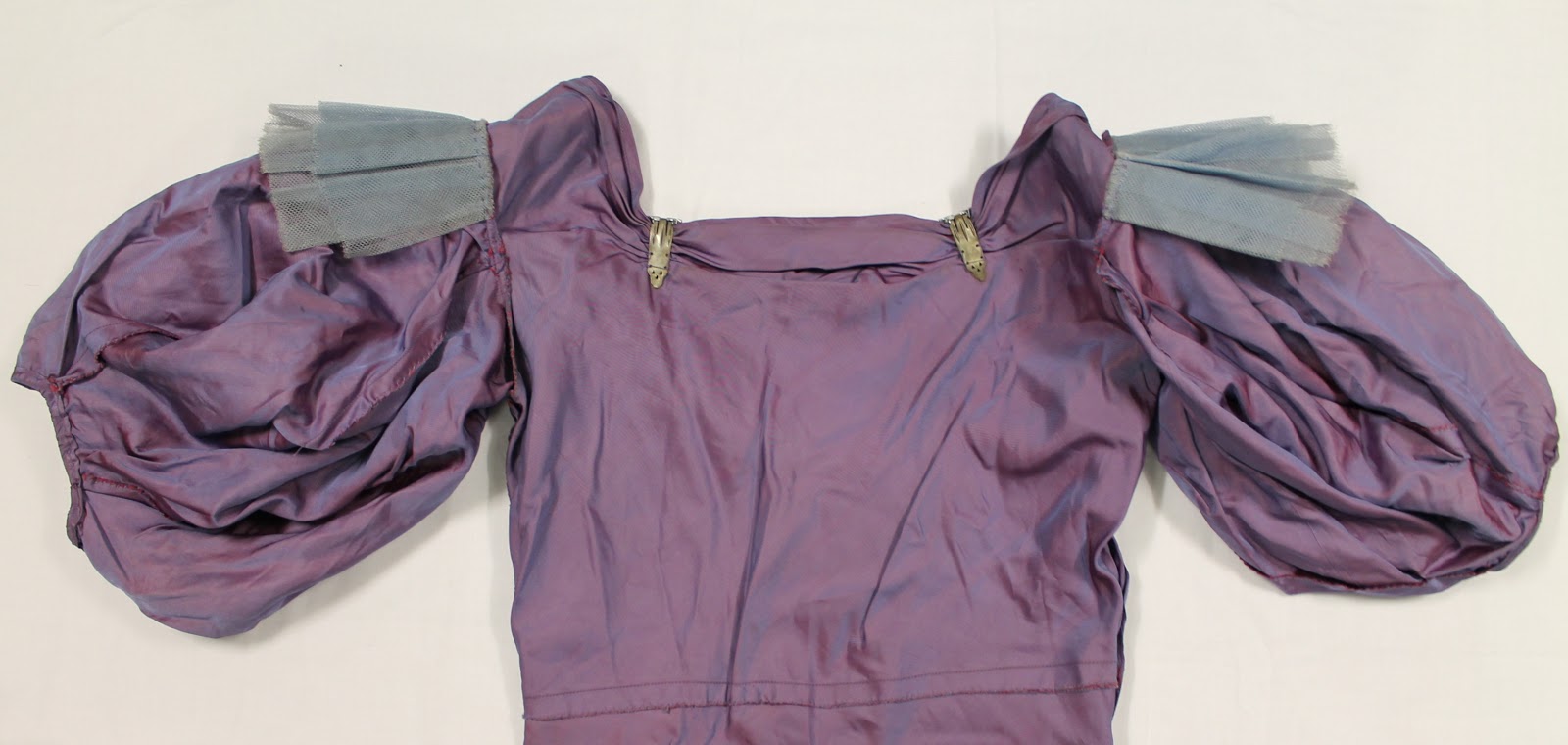
The 1930s saw the return of the natural form emphasizing the waist and bust as well as comeback of long evening dresses. The dress below is an excellent example of the dramatic but simple style that took influence specifically from American film industry.


The striking mauve colour is combined with simple lines, low v-shaped back and huge balloon sleeves, that are supported from the inside with tulle.


The dress is decorated with sewn-on dress clips which are fitted with rhinestones set in star shapes. Dress clips were widely used to add an extra sparkle to eveningwear, and they were easy to change from one dress to another.


Another lovely example of elegant eveningwear is this green velvet dress donated by Mrs. Joyce Tetley, who had bought the dress from Madame Arthur, a dressmaker from Leeds, and worn it at receptions and other formal parties at Leeds University, during the pro-chancellorship of Brigadier J. Noel Tetley from 1956-1964.


The dress has a gorgeous embroidered bodice and open back, as well as a panel at back lined with champagne satin.


Interesting detail here are the two light pink tulle rosettes inside the dress that work as an extra padding for the bust. It is alluring to think that even the details that no-one ever saw were conducted in such meticulous and beautiful way.


This is only a small sample of all the lovely dresses in the collection so look out for more blog posts about eveningwear!


Piia LempiƤinen


Friday, 4 May 2012

The Little Boy's Tailor

John Barran & Sons

As a volunteer at Leeds Museum Discovery Centre, I get the chance to work some of the fascinating objects within the vast collection. Recently, I came across a box containing this small but very special collection of childrenswear.


The group of six smocks and one coat were produced between 1910 and 1920 by John Barran & Sons – a pioneering Leeds-based firm which manufactured ready-to-wear clothing. John Barran moved to Leeds and set up business as traditional tailor and clothes dealer in 1842. In the early 1850s, he opened a shop on Briggate, where he stocked reasonably priced ready-made menswear as well as clothing for children.


The rapid growth of the ready-to-wear tailoring business was made possible by technological developments; such as sewing by machine and advances in the process of pattern cutting. Barran’s expansion of the manufacturing side of his business helped the Leeds tailoring industry evolve to produce larger quantities of better quality garments.


From an early stage Barran took a special interest in childrenswear. Clothing manufactured for boys became a major part of the business and John Barran &Sons Ltd. eventually went on to become makers of school uniforms. Orders for ready-to-wear miniature suits and coats arrived from as far as Canada, Australia, South Africa and South America.


John Barran was so well known for producing these garments especially for children, that he came to be recognised as ‘The little boy’s tailor’.

By Shauni Sanderson


Thursday, 9 February 2012

Ellen Terry centre stage again in Leeds


Ellen Terry as Portia (Merchant of Venice),
sketched by Jim Dodgson (Kester),
a member of the Leeds Savage Club.
This was probably during her 1902 tour.
 The renowned Shakespearean actress Ellen Terry (1847-1928) visited Leeds many times during her career and performed with her stage partner Henry Irving at the Leeds Grand Theatre on many occasions.

We have a number of items in the Leeds museum and gallery collections relating to this great actress and they feature in the new "Performance" exhibition now open at Abbey House Museum (until December 2012).  The display includes a beautiful cream silk dress which was reputedly designed for Ellen Terry and was worn by the actress K.L. Langstaffe when playing Desdemona in 1898.  It was originally made by a top London dressmaker, Alice Mason of 4 New Burlington St. and has been lovingly conserved by Jacqueline Hyman of Heritage Science Services (http://www.textilerestoration.co.uk/).   Jacqueline says that she felt a personal connection to the dress as she was working on it because her great-grandfather had owned a theatre in Leeds and actually knew Ellen Terry, naming Jacqueline's grandmother Ellen in her honour.

Textile conservator Jacqueline Hyman
making final adjustments to the Ellen Terry
dress for display at Abbey House.

Leeds Grand Theatre, New Briggate, Sept. 8th 1881,
Henry Irving and Ellen Terry's performance of "Hamlet"

Medallion of Ellen Terry, 1936 (plaster)
by Albert Toft (1862-1949)


Friday, 3 February 2012

Miss Bradley's tea set - a tale of factory work and marriage

Trawling through the industrial collection's accession registers this morning, I have managed to unearth the hidden story behind one of the many unprovenanced decorative Victorian tea services we have in our stores.

The story highlights the fact that although women and girls may have formed a good percentage of the workforce in many industrial mills and factories, they were not supposed to continue to work once they married.

Miss Emma Bradley (the donor's grandmother) worked for John Barran & Son Ltd. as a tailor and machinist until her marriage.  It was the practice of the firm to retire female workers when they married and this tea set was the firm's gift on this compulsory retirement.

John Barran was a pioneer in the manufacture of ready-to-wear clothing.  He started of as a traditional tailor in 1842 but soon expanded his business on an industrial scale, taking advantage of new technology such as the sewing machine.  In 1856 he had a factory with 20-30 sewing machine and in 1858 he introduced the use of a bandsaw to cut cloth.  By the 1870s he had 2,000 machines and by 1904 he employed 3,000 people.

Wool cuttling machine for folding cloth from John Barran & Sons Ltd,
on display at Leeds Industrial Museum (Armley Mills)

Female Learners Certificate of Employment
 issued by John Barran & Sons Limited, Leeds
to Amy Evelyn Brown in 1912. 
On display in The Leeds Story, Leeds City Museum