Showing posts with label World History. Show all posts

Tuesday, 1 March 2016

Mystery mug - the Jamaican connection

Creamware mug, early 19th century, Red Girls for Ever
This photograph was taken by Norman Taylor for Leeds Museums and Galleries
and is licensed under Creative Commons BY NC SA
This creamware mug has been part of the Leeds Museums collection since it was donated by Alderman Percival Tookey Leigh in 1933. It was originally attributed to the Leeds Pottery (as were many pieces of unmarked creamware) but recent research has discounted this theory and it may well turn out to have originated much further afield.

The mug has a transfer printed design of palm trees and the motto "Red Girls for Ever", neither of which seem to have much to do with Yorkshire history and until recently the meaning of the motto has remained a puzzle.  However recent internet research has revealed a possible answer.

The design appears to relate to the tradition of the Set Girl parades in early 19th century Jamaica which were held at New Year.  The tradition seems to date from the 1770s and to have originated in the French Caribbean. There were two rival factions, Reds and Blues. One theory is that the Reds represented the English and the Blues represented the Scotch. Another is that it relates to two balls for creole girls held by two admirals in the late 18th century, the "Admiral of the Red" and the "Admiral of the Blue".  The Reds and Blues seem to have held rival balls and parades which were heavily influenced by European fashion.  The motto of the Reds was "Red Girls Forever". 

Information about this tradition has been gleaned from the following sources: 
Race, Romanticism and the Atlantic, edited by Professor Paul Youngquist, Ashgate Publishing Ltd. 2013
Afro-Creole: Power, Opposition, and Play in the Caribbean
Kitty Ross, Curator of Leeds History


Monday, 23 December 2013

John "Longitude" Harrison display installed at Leeds City Museum

Audio visual content being loaded on to touchscreens.
The display is located near the front entrance of Leeds City Museum
A little tweaking to do, but the display is ready for visitors now. This display complements the displays at the Royal Observatory, Greenwich (part of the National Maritime Museum) that are dedicated to navigation, precision timekeeping and John Harrison. It is the only display outside of London about John Harrison, and, by chance, is near to his birthplace, Foulby, Wakefield. Harrison's magnificent contribution to advancing precision timekeeping cannot be overstated, equally so its significance. It not only advanced navigation science, and map making, but has also had profound effects on engineering and technology. Harrison was an autodidact, his was an intellectual journey to achieve precision timekeeping as a means of finding longitude at sea, the lack of such means being a huge problem for mariners on their journeys. Pervasive throughout cultures around the world, in art, literature, poetry, music, film and faiths, are references to journeys and navigation, to time and stars. The star of Bethlehem, guiding the three kings on their journey for example, or Eccesliastes 3:1, "There is a time for everything, and a season for every activity under the heavens". Or in literature, fiction, and non-fiction equally, from Peter Pan, and The Voyage of the Dawn Treader, to the biographies of great people like Albert Einstein, Captain James Cook, or Charles Darwin, and the voyage of the Beagle, the putative beginning of Darwin's long thinking and reflection that led to the great truth he discerned, The Origin of Species. Whenever I have encountered them, these references, they have stood out to me.
Directions to Leeds City Museum:
Second star to the right, and straight on 'til morning. Free top-ups of fairy dust available from Tinker Bell via your phone network. Your network may charge for call time. Call TINK, or 8465, to top up.

Second star to the right, and straight on 'til morning, keep on trekking!
"Location aware music" contemporary performance art and GPS combined, in a great example of the human drive to create beauty, and seek moments of awe, and using new technologies to serve this human need.
Sidereal time is the time scale that is based on the Earth's rate of rotation measured relative to the fixed stars. This is a technique that was known and used by John Harrison in regulating his timekeepers. "All men have stars, but they are not the same things for different people. For some, who are travelers, the stars are guides…."
John Harrison advanced precision timekeeping, by mechanical means, by an amount that had not been seen before or since. Today the time standard is kept by atomic clocks, that in a sense are gauging the entropy of the universe. We can understand what timekeeping is, but what is time itself? Perhaps the best explanation is the concept of the arrow of time. Albert Einstein's special theory of relativity also goes some way, perhaps, of explaining what spacetime is. Einstein also had a very good sense of humour: “When you are courting a nice girl, an hour seems like a second. When you sit on a red-hot cinder, a second seems like an hour. That's relativity.” This much is certain: time is a precious resource, not to be wasted, crack on, like smoke and oakum.

Sea Fever

BY JOHN MASEFIELD
I must go down to the seas again, to the lonely sea and the sky,
And all I ask is a tall ship and a star to steer her by;
And the wheel’s kick and the wind’s song and the white sail’s shaking,
And a grey mist on the sea’s face, and a grey dawn breaking,
I must go down to the seas again, for the call of the running tide
Is a wild call and a clear call that may not be denied;
And all I ask is a windy day with the white clouds flying,
And the flung spray and the blown spume, and the sea-gulls crying.
I must go down to the seas again, to the vagrant gypsy life,
To the gull’s way and the whale’s way where the wind’s like a whetted knife;
And all I ask is a merry yarn from a laughing fellow-rover,
And quiet sleep and a sweet dream when the long trick’s over.


The hard opening of the display was on 23/01/2014, and was marked with a very fine lecture, to an audience of nearly 180, by Dr Richard Dunn, Senior Curator, Science, Technology and Navigation, from the National Maritime Museum. 
Blog of the Board of Longitude project "Leeds leads"
Posted by Ian Fraser


Friday, 11 October 2013

Seven Views near Canton (Guangzhou) on show again at Lotherton Hall


Amongst the generous bequest to Leeds from Sir Alvary and Lady Gascoigne are this group of seven oil paintings, received in 1971. They are all show scenes from the Canton region, and they are all in similar oval frames, with outside dimensions of 280mm height and 236mm width. In 2007, when David Beevers from the Royal Pavilion in Brighton visited Leeds during research for their Chinese Whispers exhibition, he saw these paintings and helped us by asking Patrick Conner for his opinion. Patrick is a Chinese paintings expert at the firm of Martyn Gregory in London. His comments have been really useful as we prepared for the current Chinese Paintings exhibition at Lotherton Hall. He wrote:


'They are all (as you know) Cantonese 'export' paintings of c. 1850, in a style often associated with an artist known to Westerners as Namcheong. The temple scenes do not represent any particular temple, so far as anyone has ever discovered, but the pagoda is at Whampoa (modern Huangbu), a dozen miles from the city of Canton (Guangzhou) : it would have been very familiar to the crews of the Western ships who were obliged to anchor alongside Whampoa Island for several months at a time!.. The remarkable thing about the group is not the paintings but the frames. From the colour of the gilding and the sharp carving of flowers etc they look as if they could be Chinese too, in which case I've never seen anything quite like them. If they are Cantonese, they will be light (Chinese pine), and the Chinese carpentry should be obvious from the back.'


Jenny Hack, our paintings conservator at Leeds, had already investigated one of the paintings, and revealed its canvas support. Ian Fraser, the furniture conservator, was also intrigued by the wooden frames. He agrees that they are Oriental, but maybe Japanese rather than Chinese. We do hope to analyse the wood scientifically in the future.  
An essay by Peter C. Perdue in the MIT Visualizing Culture series, available online, allows us to compare several other Whampoa pagoda paintings with the two at Leeds. The essay is entitled the ‘Rise and Fall of the Canton Trade System – II, Macau and Whampoa Anchorage’ and is available at http://ocw.mit.edu/ans7870/21f/21f.027/rise_fall_canton_01/pdf/cw02_essay04.pdf. The closest painting in style to ours is one credited as “The Nine-Stage Pagoda at Whampoa Anchorage”, unknown Chinese artist, ca. 1830–50, [cwBTW_1830-50_Whampoa].
 
Looking closely at the paintings you can almost read the characters on the red festival banners hanging either side of the door in this work. Maybe the sampan owners have come to help with a major celebration.


We have also noticed that the triple moon windows in the memorial gate in this painting, are echoed in a modern way in the architecture plans for the new Guangzhou Art Museum.

In the Leeds collections we have a large model junk that would match up well with one of the paintings.  

It is currently on show in the 'Fate and Fickle Fortune' exhibiton at Abbey House, for visitors to admire the lucky eyes on the prows. Another key item  in the Leeds collections, reflecting the importance of the Canton trade, is this 18th century punch bowl featuring the European trade factories of Canton, very similar to the one at the Peabody Museum, Essex. The Leeds bowl (LEEAG.CE.1967.24.29), is painted in fine grisaille detail, with a view of the East India Company ship, Pitt, in the centre. 


Hopefully more images of these Chinese export trade items will be available on our own collections website next year, as we are undergoing a major revamp at the moment.

Antonia Lovelace (Curator of World Cultures) and Estelle Wu (intern) 


Tuesday, 25 June 2013

A New Display of Frank Savery's collection of
Chinese ceramics at Leeds City Museum in the
Collector's Cabinet gallery

by Angel Choi On Ki
 

Are you a fan of ancient Chinese ceramics? Recently a Chinese intern at Leeds Museums and Galleries, Rane Pike, made a selection from the generous bequest of more than 270 rare Chinese ceramics by Frank Savery, for a display in the Collector's Cabinet gallery at Leeds City Museum. Now her display is on show, allowing visitors to Leeds city centre to see 42 pieces from this collection, which is also on show at Lotherton Hall, near Aberford, to the northeast of Leeds. The Savery bequest came to Leeds in 1966, after many years of collaboration between the collector and the city's Art Gallery service. Born in Huddersfield, Savery gradually built up his collection whilst working for the Foreign Office. He was the Consul General in Warsaw for many years until the outbreak of World War II in 1939, and then served in the exiled Polish embassy in London. He mainly acquired his pieces by purchase from the London antique dealers, Bluett and Sons. Unusually for the time, Savery had a deep interest in early Chinese ceramics, rather than the better known blue and white porcelains, or later multi-colored enamels.

Located next to a large introductory text panel with a map of the main kiln sites in China, the ceramics are neatly arranged in a four-shelved glass cupboard. The text panel discusses the four topics chosen for display, from celadons on the top shelf, sancai or three colour glazes on the next, then chazhan (tea bowls), and finally a range of different techiques on the bottom shelf.  This selection came out of an in depth review of the collection as a whole, picking up on previous display strengths and the personal interest of the intern guiding the preparations. It should appeal to both the general visitors and those already converted to an appreciation of  early Chinese ceramics.

The display is very carefully arranged and uses some of the original Chinese silk covered gift boxes to vary and increase the height of presentation on each shelf (as here with two of the tea bowls). This was an issue as many of the ceramics are quite small and might otherwise not attract much attention. The intern and curator had to plan carefully which shelf to use for which selection, and the tea bowls with their delicate internal patterning are most easily visible on the third shelf. It is a little harder to appreciate the range of watery greens of the celadons on the top shelf. 
 
Among the different ceramics shown, there is a sancai vase which captured my attention immediately. The vase is brilliant, with three lively colors combining evenly - brown, green and yellow. Also the shape is beautiful – a flat mouth, a narrow neck, a round body mimicking a melon, followed by a base which expands outwards. Personally I love sancai (its other name is Tang sancai as it was so popular in the Tang Dynasty (618-907 AD). It demonstrates the vibrant history of China, as the ceramic technique of applying and mixing these glazes was so amazingly advanced at the time. I also think its origin is intriguing, as the sancai ceramics were mainly, if not all, found in tombs, where they were placed to accompany the deceased into the afterlife. Related to death, the vase shows another side of life and leads me to think about the many issues of life and death. 

In the future the display could maybe be improved by introducing a few angled mirrors to enable more details of particular ceramics to be visible to the visitor, by reflecting the image downwards. Perhaps some of the very lovely details on the tea bowls could be emphasised by photographic enlargements placed nearby. And maybe it would be good to have a glimpse of the other Savery pieces on show at Lotherton Hall by having a digital slide show on a small screen inside the case. Many visitors might like to know a bit more about the popular tea culture in China, both in the Song dynasty and now, and this could be presented in the format of a Find Out More A4 information sheet, as elsewhere in the City Museum.  To conclude, I enjoyed the exhibition very much, and it gives a good impression of this wide ranging Chinese ceramics collection. Some pices I have never even seen in my home country as well. It is definitely worth a visit!


Monday, 18 February 2013

Sharing Appreciation of Islamic Art

A table at the Discover Islam Week, Parkinson Court,
University of Leeds

By Antonia Lovelace and Gabrielle Hamilton
It was great to be invited to participate in the University of  Leeds' Islamic Society's Discover Islam week again this year. We took seven items, including the Khanga cloth from Tanzania that we hung at the front of our table. Our most prized Islamic item, a fragment of the Kaaba cloth from 1917 took pride of place and we also exhibited a Turkish waistcoat, c. 1900 with stylised Arabic calligraphy in a very fine chain stitch and a Turkish necklace with brass coins. Two items prompted the most enthusiastic conversations, a Takhti, or writing board from Pakistan with an ink packet (entitled Churaj Roshani - or bringer of light), clay and pen (kolam), bought in Pakistan in 1975 by a previous curator, which Irfan Raja and others commented on, who had learnt their first letters using such a board, 

and the seal and manuscripts from Nepal belonging to Maharaj Rana Singh Bahadoor. Several people have asked for the longer Persian text to be sent to them by e-mail, so hopefully we may get a translation of key elements of this quite soon.
Two readers were able to give us the date on the longest manuscript - 13 July 1879.

Thank you to Zaki Al-Ghazal for inviting us to the event, which continues for the rest of the week (though we could only be there for today), and a big thank you to Ismail Hussayn, the Arabic calligrapher, who kindly wrote
VOICES OF ASIA, the title of the redisplay we are planning for Leeds City Museum World View gallery, for us:
You can find Ismail at twitter@IsmailHussayn


Thursday, 7 February 2013

Snakes Come Out for Chinese New Year of the Snake
                        by Antonia Lovelace and Sinny Cheung


This weekend it's Chinese New Year and we are taking some snake objects (not real snakes!) along to an event at Headingley Library (Saturday 9th February 10 to 2), and to the big celebration by Leeds Chinese Community Association at Leeds Town Hall on Sunday 10th February. According to the Chinese Zodiac people born in the year of the snake are wise, enthusiastic and attractive, but sometimes conceited, stingy and unfaithful. You are likely to be a Snake Chinese Zodiac person if you were born in 1953, 1965, 1977, 2001 and this year too - 2013. The red paper-cut snake shown here is one of a set of 12 donated to the museum in 2008 by Suna Zie who was working with us on the Chinese Treasures project. They were made by her mother. You can see several from the whole set in the Fate and Fickle Fortune exhibition that opened recently at Abbey House Museum.


Looking for toy snakes that would appeal to family participants we've chosen a colourful beaded Turkish snake, eating a lizard, from 1917, and a plastic snake, made in China from the early 1970s.

I definitely remember playing with a similar bendy snake as a child.
The name is fabulous ' Wriggly Billy'!  If you come and meet us you will also see a real python skin, on loan from HMS Customs.
As dragons are also another Chinese Zodiac animal and very LUCKY we will bring some Chinese dragons along too: a hundred year old embroidered panel with a five clawed golden dragon and a modern dragon puppet.

Leeds Museums and Galleries has helped in the Leeds Chinese Community Association New Year celebrations for many years, beginning in a big way in 2007, the year before the Chinese Treasures exhibition. We will be working with them again for the Voices of Asia project,  the major redisplay in the World View Gallery at Leeds City Museum, that is due to open in Spring 2014.

Photos from Headingley Library Chinese New Year on Sat 9 February:


Photos from Leeds Chinese Community Association big celebration in Leeds Town Hall


Wednesday, 14 November 2012

Lotherton Hall’s Oriental Gallery is being de-installed to make way for new interpretation on the history of the house.

The gallery opened on October 14 1975, as a conversion of the servant’s quarters (which included a housekeeper’s room, servants hall and gun room) in the north wing. Now, 37 years later, the plan is to reinstate these rooms, or at least an impression of them, and provide more space for informal education and a more detailed history of the house. In 1975 Lady Gascoigne, and the then director of Leeds Art Galleries, Robert Rowe, were keen to display the Frank Savery bequest of early Chinese ceramics, given to Temple Newsam in 1966, as well as the Gascoigne’s own Oriental treasures. The latter were few in number, but quite stunning to view.
The best known is the Tang period Chinese camel which “commanded the entrance” to the new gallery, and the pair of Japanese screens. The foyer before the gallery included a shop, which in early 2012 moved out of Lotherton Hall itself to the stable yard, as part of the development of a single entrance fee and more integrated offer for the whole estate.

Robert Rowe described the 1975 Oriental Gallery plans thus: ‘A great deal of thought has gone into the display units and lighting systems with the result, we hope, that the objects will be seen under conditions worthy of them. Flexibility has been a major consideration as well: to show off the beauties of a Neolithic pot, for example, it should be possible to show it in different lights and against a variety of backgrounds’ (Leeds Art Calendar 1974). A gallery view in the 1975 guide book shows a mainly cream and beige colour scheme, with contemporary low tables set against a deep red carpet, whose red was picked up by the plinths of two large island cases. The case surrounds were of polished steel or aluminium.

Two black and white photographs of the Oriental Gallery from 1975 survive, one of the same view as the colour image in the brochure, and this second one, giving a view looking back to the entrance way.

In the 1990s the colour scheme was changed by Daru Rooke, to be more sympathetic to the period interiors of the house, and to an ‘antique’ Chinese feel, using green, red and blue paint on the walls. Gilt framed paintings of boats on rivers and lovers beside lakes, by European influenced Chinese painters, were hung against the blue, and mahogany toned wood facings covered over the white metallic case edgings. Lighter grained wooden bases inside the cases improved the ambience of the chronological Chinese ceramics display.

In the last 37 years the Oriental Gallery has also hosted some major exhibitions. In the early 1980s there was an exhibition on Armorial porcelains, in the 1990s the Legacy of William Morris’ Art Pottery, in 2001 Tales from Japan, and in 2008 Chinese Treasures. 


In 1998, after several years of preparation and a donation of her own funds as seed-money, Hanna Sutcliffe wrote her booklet ‘Chinese Ceramics at Lotherton Hall, Leeds’, which was published by Leeds Museums and Galleries and has been on sale ever since. On Friday 2 November 2012 we invited her to revisit the Oriental Gallery to be filmed for our records, just before the de-install. She remains as enthusiastic in her appreciation of the collection, and talked on film about the Central or South Asian dancing boy tomb figure, the green lead glazed Han dynasty jars, a celadon tripod offering bowl and water vessel, and the cizhou ware painted pillow with the scene of the three scholars and the inscribed stele. We hope to edit this film over the next few months and publish extracts from it on the web next year.

Meanwhile a new intern with Leeds Museums and Galleries, Rane Qiaoqian (now Rane Pike), will be reviewing the Frank Savery collection, and helping us to select a range of early pieces, Sancai wares, Song tea bowls, celadons, and other stunning technical virtuosities, from his 300 plus donation for show in the Collector’s gallery at Leeds City Museum in 2013. The study alcove at the far end of what is now the Lotherton Hall Oriental Gallery will remain dedicated to Chinese ceramics, when the gallery space re-opens in its new guise later the same year.


By Antonia Lovelace, Curator (World Cultures) November 2012


Monday, 17 September 2012

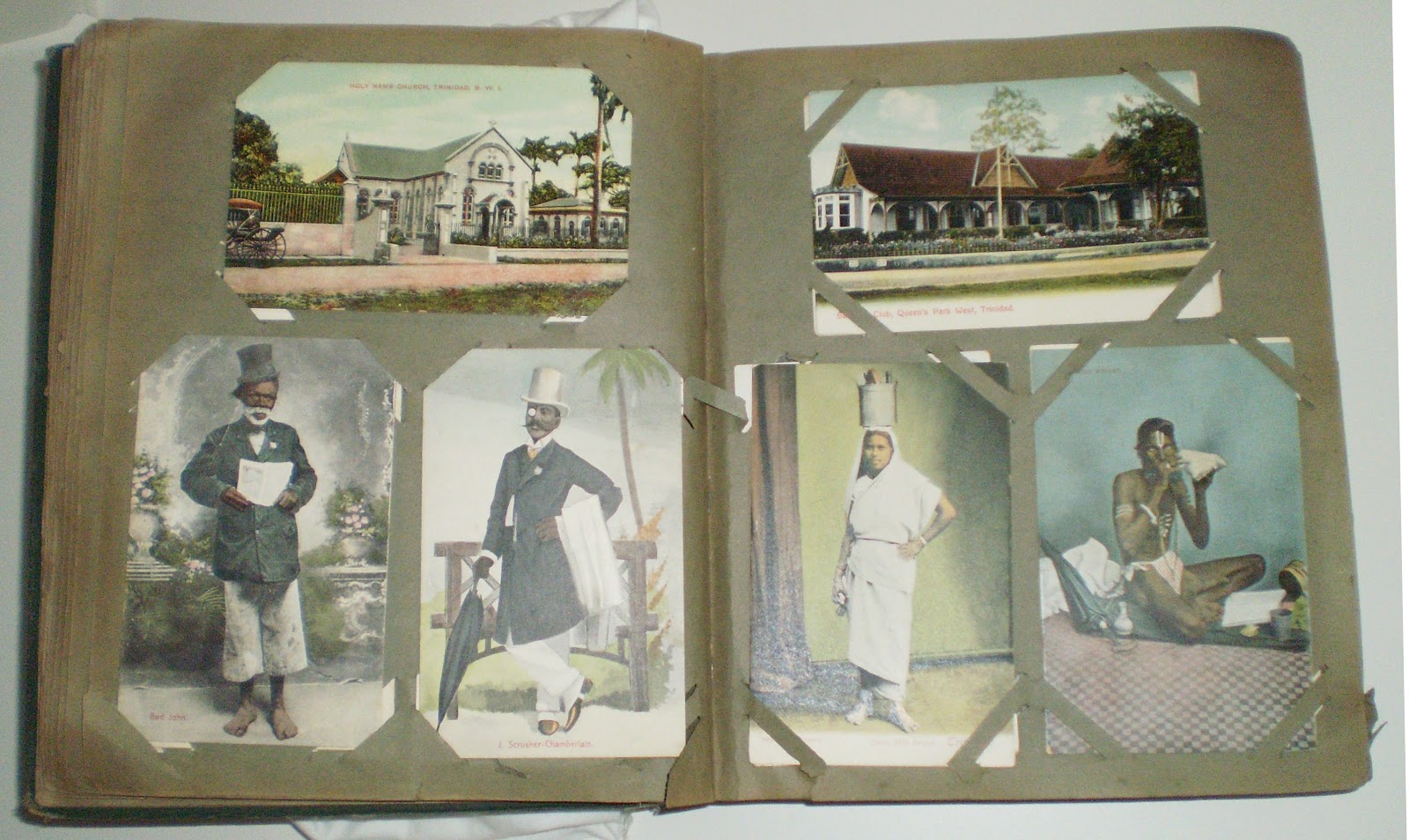
Caribbean postcards in a Leeds album 1906-1915


In response to the UK National Archives 'Caribbean Through a Lens Project' we have started to look again through a Leeds postcard album with 396 postcards, mainly from Trinidad (312), from the early 1900s. You can find the National Archives photographs on Flickr at http://www.flickr.com/photos/nationalarchives/collections/72157630635006206/

The Leeds album has 132 pages with 3 postcards per page, and the images range from famous buildings, studio images of local personalities (see 'Bad John' and J. Scrusher-Chamberlain in the page open here), and popular images of 'East Indians', who had come to Trinidad as indentured labourers.

They also include fruit, trees and birds, and local industries like digging for pitch at La Brea. The dull green paper has become so acidic we are taking the postcards out, and storing them from now on in a secol pocket system in binders. We will keep the album too though.


A few of the postcards are locally made photographs, printed onto postcard card, and some are photographs on photographic paper (see above).  The photogtraph of the couple sitting in the waves on Huevos Island are probably members of the Leeds family who put the album together (the Tomlinsons, see below). The house photograph has a hand-written caption on the back: "This is part of the front of Aunt Modie's house". The end of the album includes cards from Barbados (21), Tobago (15), Venezuala (18), Colombia (8), Panama (19), and the Azores. We have no donor listed for the album, but examining the 36 postcards that have been posted they were all sent to various members of the Tomlinson family, at The Beeches, Colton, nr Leeds. Some are from an 'Auntie', and some are from an E. Tomlinson.  The dates on these posted cards range from 1906 to 1915. The album has obviously been completed with care, maybe by one or more of the family once they returned from their time in Trinidad. If only we knew why they had stayed there for these few years, and if they stayed with other relatives who might still be there.

The plan is to do work with Leeds West Indian Centre, and Leeds Black Elders, to get input and comments on a selection of these postcards, during joint workshops next year (2013) when a selection of photographs from the National Archives project will also be shown. Meanwhile we will hopefuly have time to scan the Leeds album postcards individually, compare them with ones already available on line, and do some in-depth research where possible, on the places and people shown. This is a great group of postcards because of the sheer number and variety of them, from the same time period. It is going to be a treat to work on them.


Thursday, 10 May 2012

Stichting Ebenist, 11th International Symposium for Wood and Furniture Conservation, Amsterdam, November 2012

Stichting Ebenist is an organisation of conservation professionals in the Netherlands and their conferences in relation to wood and furniture conservation are established now as the premier such event globally, attracting an international audience, similarly speakers. The theme for the 2012 conference is Reproduction and Reconstruction in Furniture Conservation. Delegates for the upcoming conference will be getting a Temple Newsam double whammy: a paper on the re-construction of the Queen Anne State Bed, from Ian Fraser, Temple Newsam's furniture conservator:
And a paper from Temple Newsam's retired senior curator Anthony Wells-Cole into the research and virtual re-construction that he has been working on in relation to the 17th century Japanese lacquer columns and mouldings of the Temple Newsam lacquer secretaire, and upright piano, both supplied in the 19th century, and kept in the Chinese Room. The Japanese lacquer columns and mouldings once formed part of a highly elaborate balustrade in the bedchamber of Amalia van Solms, wife of the Stadholder of The Hague. They lived in Huis ten Bosch, a palace in The Hague, The Netherlands. Commissioned by the occupants, and probably the first European commission of Japanese lacquer work, the components arrived in the 1630s, were installed and stayed there until the Napoleonic Wars. French troops overran the Low Countries, and Huis ten Bosch was ransacked. The Japanese lacquer components, war booty, start turning up in the furniture trades in London and Paris in the 19th century, and being added to pieces of furniture. A fascinating backstory, and one of the aims of Mr Wells-Coles's research has been trying to visualise what the bed balustrade looked like in Huis ten Bosch. Of outstanding quality, the scenes depicted on the columns tell the ancient story "The Tales of Ise".


Tuesday, 3 April 2012

Taxidermy and T-Shirts Changing Lives!

It is because sometimes small, seemingly innocuous, innocent and meaningless things take some time to reveal themselves for what they really are that I find myself writing about the fabulous, inspirational qualities of a small song thrush and an "Obama for President" t-shirt because I believe these items to be the most recent items in the collections which may have changed the future for two people in Leeds.

We recently took an enquiry from a life coach who asked if we had any birds "which don't move" in order to try and help a client with, what transpired to be, a crippling fear of all things avian. With special permission to allow the gloved client to stroke the taxidermy (sufficiently robust specimens only), we embarked on a journey of discovery into what it was about birds which caused the problem.

Needless to say, on account of not wanting to completely terrify anyone, we did not go into the museum store but instead, I spent a happy hour going backwards and forwards extracting various specimens including a badly painted iguana (to see if staring, black eyes in other creatures was the problem) and some bird skulls (to show how different bird beak equipment is adapted to the primary function of finding food in order to stay alive).


As someone who regularly suggests to children that the things in LMDC store may come to life at night, this was one time I kept my mouth firmly shut, watching the counsellor ply her trade and was very glad that there was no sign of tweeting, flapping, ruffling or pecking, enabling the client to move (from their own reckoning) from a 9/10 fear rating a the start of the session to a 5/10 at the end.

I must admit that seeing a grown adult recoil with such horror when the birds were first put down on the table in front of them was a sobering and uncomfortable experience tempered only by the thought that his was an odd but extremely worthwhile use of the collections. Watching as the client was slowly able to relax, move the bird closer and eventually reach out a gloved hand gently to stroke the feathers and appreciate some of the beauty of the shapes, colours and patterns was, for me, a "Kodak" moment.

The visit to Disco was one small part of a ten-part plan of therapy and I  felt honoured to have been allowed to be part of a possibly life-changing moment in someone else's life.

Similarly but at the other end of the scale, I was recently on outreach at Armley Christ Church Primary School discussing with children (9 or 10 years old) why on earth the museum lady brought out a modern American t-shirt depicting Barack Obama when the topic was supposed to be about Africa!

Some time later, after lots of “I think it’s because he might be famous…” (the image showing him holding a microphone probably made the children wonder whether or not he’d been on X Factor), we eventually got to the gentleman’s job title, mentioning his epithet of being the FIRST man of African-American heritage to be President of the United States.


Blank faces. So what.

I asked if anyone knew what they used to do to / think of / how they used to treat black people in America.

All eyes studying the tables.

I asked if anyone had heard of the story of Rosa Parks…only to be bombarded with children proudly telling me all the details of the story from what turned out to be the topic of their last lesson. Did we think there might be a link between the two?

Nothing.

And then the penny dropped (at least for some people) and the light bulbs blazed as they remembered what they’d been taught about slavery, slave ships, sugar plantations and the Slave Trade Triangle.

Success (I think)!

It was only after the end of the session, however, that a young lady who had spent most of the session trying really hard to answer questions said thoughtfully:

“Perhaps, do you think that might mean I could be the next black, lady Prime Minister?”

I for one shall certainly be watching the future candidates lists very carefully. Leeds Museums and Galleries: providing inspiration from t-shirts and taxidermy!