Tuesday, 2 October 2012

'All You Need Is Love' a celebration of love & commitment

The Community History Team has been working on a film project with a selection of local couples from different backgrounds to explore the theme of love and commitment. The project has focused on the rituals and traditions associated with different unions, faiths and cultures. Our five couples have been interviewed and filmed at home talking about their individual stories of 'courtship' and ‘tying the knot’.

Kate & Helen
(personal image from their wedding album)
This has included couples who are already married, those planning to get married in the very near future and one couple who have entered into a Civil Partnership. The couples all have a connection to Leeds and shared their tales of how they met, when and how they decided to make a long term commitment, their hopes for the ‘big day’ and their life together afterwards – what makes for a happy marriage. 

Our co-curated display to accompany the film will include the wedding attire borrowed from the five couples, ephemera from the day and some of the Leeds Museums and Galleries collections connected to the theme, from Greek wedding bread to Thai silk given as a gift to the wedding guests. All the footage was shot between July and September of this year.

Here are a couple of images from the five film shoots we did with Digifish Media Productions:
Julia & Stephen
(behind the scenes image of film shoot with Paul and Ollie) 

Zofia & Kieran
(behind the scenes image of film shoot with Paul and Ollie) 

All of the objects collected and footage captured will be on display in the Leeds City Museum (The Leeds Story Gallery - Community History Cases) from mid December 2012 until mid July 2013.

There will also be a display of paintings on the community corridor on the theme of ‘Enduring Love’ curated by local artist Marcia Brown and her students.

Author: Marek Romaniszyn (Assistant Curator of Community History)


Monday, 24 September 2012

Curatorial and conservation support for Keeping Time exhibition at Fairfax House, York


Fairfax House, York, is holding an exhibition, Keeping Time. This exhibition focuses on and celebrates the excellence and innovation of clock and scientific instrument makers from Yorkshire. Centrepiece of the exhibition is the John Harrison precision pendulum clock No. 2, on which Harrison began his precision timekeeping research in response to the Longitude Act of 1714. Harrison's research eventually led to the practical solution to determining longitude. Not knowing one's longitude was a major navigational problem, and had often spelt disaster for mariners, either getting lost, or running into obstacles, running out of sea room, and ending up on lee shores. This Harrison clock has been written about in earlier blogs, under History of Science. Loaned from Leeds Museums and Galleries, the exhibition opens on 5 October, 2012 and runs through to the end of December. Following on from suggestions from LMG staff, Fairfax House has also borrowed the Harrison brothers sundial made for Holy Trinity Church, Barrow-upon-Humber, and the highly signficant equatorially mounted telescope, made by Henry Hindley of York, and which is part of the scientific instruments and specimens collection at Burton Constable Hall.

http://www.fairfaxhouse.co.uk/?idno=687&id=132

http://www.burtonconstable.com


Monday, 17 September 2012

Caribbean postcards in a Leeds album 1906-1915


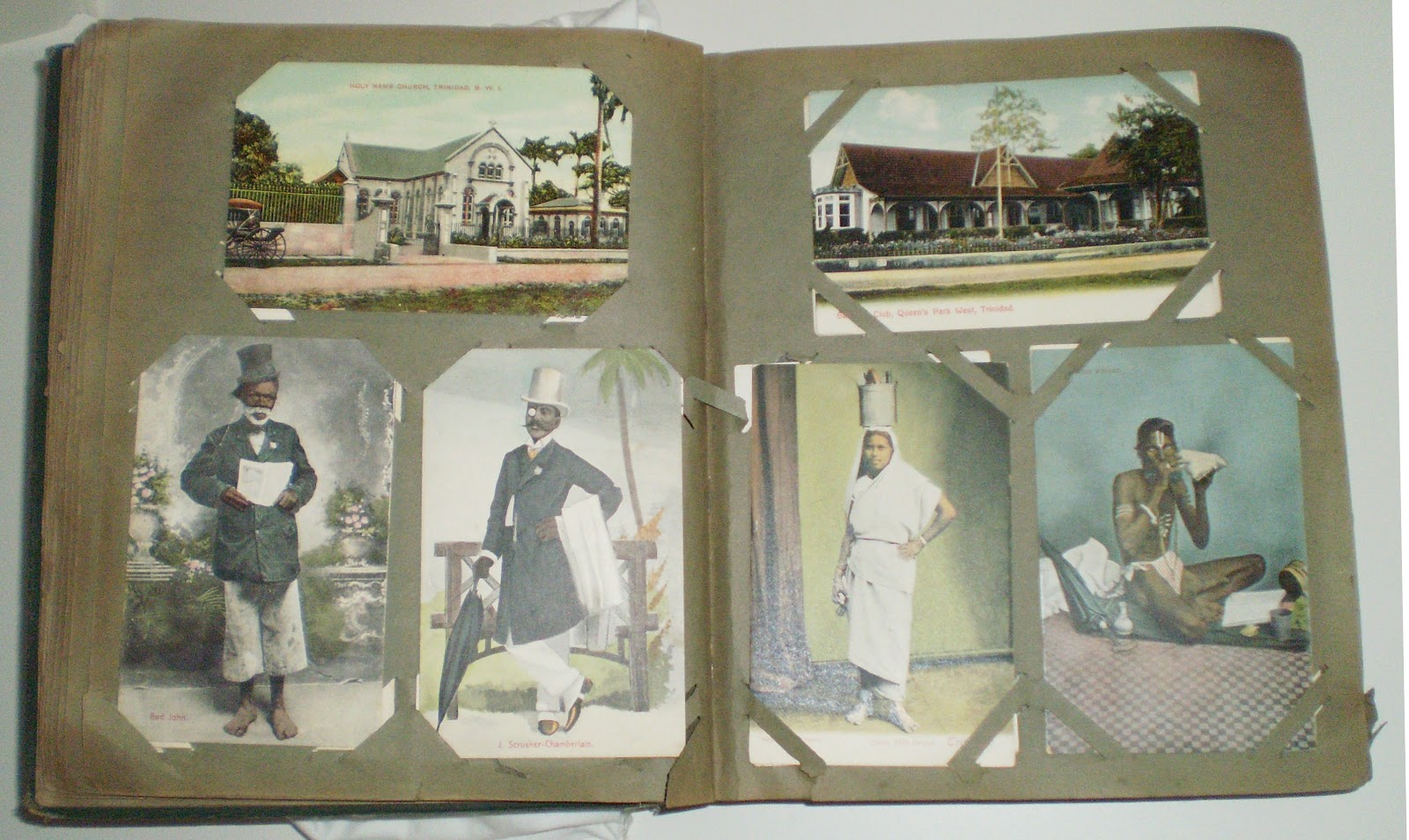
In response to the UK National Archives 'Caribbean Through a Lens Project' we have started to look again through a Leeds postcard album with 396 postcards, mainly from Trinidad (312), from the early 1900s. You can find the National Archives photographs on Flickr at http://www.flickr.com/photos/nationalarchives/collections/72157630635006206/

The Leeds album has 132 pages with 3 postcards per page, and the images range from famous buildings, studio images of local personalities (see 'Bad John' and J. Scrusher-Chamberlain in the page open here), and popular images of 'East Indians', who had come to Trinidad as indentured labourers.

They also include fruit, trees and birds, and local industries like digging for pitch at La Brea. The dull green paper has become so acidic we are taking the postcards out, and storing them from now on in a secol pocket system in binders. We will keep the album too though.


A few of the postcards are locally made photographs, printed onto postcard card, and some are photographs on photographic paper (see above).  The photogtraph of the couple sitting in the waves on Huevos Island are probably members of the Leeds family who put the album together (the Tomlinsons, see below). The house photograph has a hand-written caption on the back: "This is part of the front of Aunt Modie's house". The end of the album includes cards from Barbados (21), Tobago (15), Venezuala (18), Colombia (8), Panama (19), and the Azores. We have no donor listed for the album, but examining the 36 postcards that have been posted they were all sent to various members of the Tomlinson family, at The Beeches, Colton, nr Leeds. Some are from an 'Auntie', and some are from an E. Tomlinson.  The dates on these posted cards range from 1906 to 1915. The album has obviously been completed with care, maybe by one or more of the family once they returned from their time in Trinidad. If only we knew why they had stayed there for these few years, and if they stayed with other relatives who might still be there.

The plan is to do work with Leeds West Indian Centre, and Leeds Black Elders, to get input and comments on a selection of these postcards, during joint workshops next year (2013) when a selection of photographs from the National Archives project will also be shown. Meanwhile we will hopefuly have time to scan the Leeds album postcards individually, compare them with ones already available on line, and do some in-depth research where possible, on the places and people shown. This is a great group of postcards because of the sheer number and variety of them, from the same time period. It is going to be a treat to work on them.


Friday, 27 July 2012

All the bells...

At 8.12 this morning, we were stood outside Abbey House Museum ringing servants bells and a cowbell, as part of Martin Creed's Work No. 1197. Hopefully we were joined by thousands of others around the country celebrating the start of a great summer event.


Wednesday, 25 July 2012

Fun and games at Abbey House

In the social history department we have collections of objects relating to all  aspects of every day life – be it daily household living, sports and social activities or working life. I have recently had the chance to develop my knowledge of one particularly interesting area of the collection – our toys and games!

At Abbey House Museum we are soon to be re-displaying one of our galleries, and are taking the opportunity to showcase some of the fantastic ‘boys toys’ we have in the collection. I say ‘boys toys’ as they are the toys traditionally associated with boys, but don’t worry – hopefully they are something everyone can enjoy. As a bit of a teaser for  later in the Autumn , I thought I’d share a couple of my favourites so far.

This garage was manufactured in Germany by Schuco, but the original catalogue entry had little other information. Using the internet I managed to find a picture of an identical one online, which gave me a manufacture date of around 1938. At first glance the telephone seemed rather large and conspicuous, but I wasn’t immediately sure why. Then underneath the website description it gave instructions on ways to open the garage. This was either by pulling the phone cord or pressing down on the phone cradle. I gave it a go and the doors popped straight open and out rolled a black car I hadn’t known was there!


LEEDM.E.2012.0368


My next choice is a horsebox. As with a number of our cars and trains it still lives in an immaculate box and has not really been touched for many years, if ever. I read on the side that the item was a horsebox, so when I took it out of the box to get a photograph I noticed two pairs of legs in the window. After carefully managing to get the door open, it soon became obvious that the horse was upside down. After looking into an identical horsebox, I found that the horse was in the same position which got me to thinking – how many previous owners of this particular model of train carriage had kept it in mint boxed condition, and never even realised that their horse was upside down!


LEEDM.E.1966.0034.0012.B

This final item is probably my favourite so far. We have a large collection of boxed corgi cars dating from the 1960s that were bought at the time for the museum collection. Some of these are beautifully put together sets with several boxed cars and are now highly sought after items. My personal favourite is Corgi Gift Set No. 15 – the Silverstone Circuit racing set. The set itself comes complete with everything you need from a plastic mat to act as a display circuit to cars, press boxes and race officials. It also includes paints and glue for assembling the parts of the stands. Once this came out of the box it was popular with everyone who saw it, so it has temporarily been put on display at Leeds Museums Discovery Centre until August, and will be transferred over to Abbey House in the Autumn.


LEEDM.E.1964.0090.0017


Nicola Pullan
Assistant Curator of Leeds and Social History


Wednesday, 18 July 2012

The Pharaohs have left the building

After over 4 months in Leeds City Museum, the pharaohs have now left Yorkshire.

'Pharaoh: King of Egypt', a touring exhibition showcasing over 130 Egyptology artefacts from the British Museum's collections, proved to be a massive hit with the people of Leeds.  It was visited by over 74,000 people, the most popular temporary exhibition to date, and we have had lots of feedback and requests for more of the same in the future.

The exhibition from the balcony of Leeds City Museum's Arena
Tomb guardian of Pharaoh Ramses I from the Valley of the Kings, Thebes, 1295-1294 BC

It was sad to say goodbye to some iconic Egyptian artefacts, all of which are now on display in Birmingham Museum until 14th October.  As for the Arena in Leeds City Museum, it has now been transformed back to its original state and visitors can now walk across the giant map of Leeds once more.

To find out more about the tour of 'Pharaoh: King of Egypt' across the UK, visit: http://www.britishmuseum.org/whats_on/uk_tours_and_loans/pharaoh_king_of_egypt.aspx

Katherine Baxter
Curator of Archaeology
Leeds Museums and Galleries