Monday, 14 January 2013

Reading Money

When you begin to try and identify a coin, sometimes what you assume to be most straight-forward turns out to be surprisingly complicated. One example is simply trying to read legend (words around the edge) of a coin. Often a shorthand is used to abbreviate the words so that they fit the space - in order to understand what they mean, skills from other disciplines need to be used to understand the meaning of the dots and dashes used. Palaeography is one such skill.

Palaeography is the study of manuscripts – of how they are put together and how they are written. It was common scribal practise to abbreviate common words used in manuscripts. Often, parts of the endings were missed off this saved time and space on expensive parchment. A similar practise we see happening on coins, especially those of eleventh century England.

One coin in particular shows us several ways to abbreviate words:
LEEDS.N.2010.0059.0003.O

On the obverse, Anglo is abbreviated by joining a small x to the word, representing the unabbreviated form Anglorum. The x represents the –rum ending, shown below:


On the reverse of the same coin, further ways to abbreviate words are seen:


LEEDS.N.2010.0059.0003.R

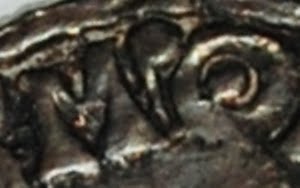
On the left hand side, between the M and the O is a hyphen. At the end of the legend is a high pellet. In the middle over the A is a superscript line. The hyphen shows a contraction of the MONETA (meaning money) to M-O:

The pellet shows a contraction of the name EORFORPIC (York) to EO.:


The superscript line shows another contraction, this time of an entire word, ANGLORUM, to a single letter A:


However these conventions are not static and they do alter between different coins, or rather, different moneyers used different conventions particular to themselves to contract different words.

LEEDS.N.2010.0060.O

In this example the –rum of Anglorum is shortened by a pellet inside the O, rather than with a conjoined x.


On the reverse of the coin the contractions of Moneta and Eoforic are also shown differently:

LEEDS.N.2010.0060.R

An apostrophe, as well as a central pellet contracts Moneta:


And Eoforic is contracted by an internal pellet, not even at the end of the letter group:


Multiple marks of the same type are used as well. In this example, a double pellet stands in for the –m at the end of Anglorum:


The study of abbreviations in manuscripts and their similarities to those on coins is an area that has not been systematically studied. Conventions from manuscripts are certainly brought into the die-cutting, but are they standardised? This brief survey suggests large differences between die-cutters who were producing coins and the choices of abbreviation that they made. It appears too that there is an awareness of how abbreviations were used in manuscripts and the letter formation there.

All the coins discussed here date to the early eleventh century under the reign of Ethelred. This is a “middle period” according to Bischoff in Latin Palaeography where “a supply of abbreviations and their usage was established”. Bischoff is telling us that at the same time as these coins were being made, conventions within manuscript tradition were not set yet. It is a period of transformation and standardisation for the different media that used writing. Coins should be very much included!


Lucy Moore


Sunday, 6 January 2013

Time is fleeting.....

Re-assembly at LMDC
Harrison clock movement being prepared for transport


Hindley telescope in its showcase for Keeping Time 


Matthew Read preparing the telescope for transport


The "Keeping Time" exhibition at Fairfax House, York, ended on 30 December 2012, and Friday 4 January 2013 two of the star items, the John "Longitude" Harrison clock, of 1727, from Leeds Museums and Galleries, and the Henry Hindley telescope, of 1742, from Burton Constable Hall, were dismantled and prepared for transport with the expert help of Matthew Read, clocks programme tutor at West Dean College, and one of his students, Tim Hughes. The Harrison clock is safely back at Leeds Museum Discovery Centre. The Hindley telescope is at West Dean College now for an extensive programme of conservation and recording, a project that is being funded by a very generous donor, Josie Rowland. The telescope has been blogged about before, it is of tremendous importance within the history of scientific instruments, being the first-ever equatorially mounted telescope, with some technical details about the thread-cutting that has even Matthew a little puzzled. The full dismantling, recording and analysis should be very revealing. The other one made by Hindley is at the Science Museum. There will be blogs about this project as it progresses. The aim is to share the information gained as widely as possible, and to that end a study day is planned, as are papers for Antiquarian Horology Society, and the Scientific Instrument Society. Its display and interpretation at Burton Constable Hall will be informed by what is revealed, as well as the historic context. The dance of communication between curator, conservator and education specialists is what creates the unique offer for visitors that great museums aspire to, and the curatorial committee at Burton Constable Hall, of which I am a member, is looking forward to making the most of this unique and significant navigational and astronomical instrument.

Antiquarian Horological Society
Scientific Instrument Society
West Dean College
http://en.wikipedia.org/wiki/Henry_Hindley
Burton Constable Hall
Equatorial mounts

Posted by Ian Fraser


Friday, 14 December 2012

An evening dress by Norman Hartnell

Last time I wrote about festive party frocks of early 20th century, and promised to continue on the subject. Recently I came across a lovely evening dress from 1930s, designed by Norman Hartnell, and I just had to write about it.


Norman Hartnell (1901-1979) was one of the most prominent British designers of the 20th century, and also dressmaker for Queen Mary, Queen Elizabeth, and Queen Elizabeth II. He started his own company in 1923, after leaving Cambridge without a degree and working with other designers, such as Lady Duff-Gordon, better known as Lucile.

Hartnell’s style was opulent and decorative and he specialised in lavish embroideries employing an in-house embroidery workroom. He offered British haute couture for both domestic and foreign clientele, specializing in creating ethereal and alluring evening gowns and afternoon dresses for the elite, but he also produced variety of ready-to-wear, shoe, perfume, jewellery, bridal and menswear collections over the decades.
However, he is best remembered for dressing the royals. Hartnell gained the favour of the court when he designed the wedding dress and trousseau for Lady Alice Montagu-Douglas-Scott, marrying Duke of Gloucester in 1935. After that, both Queen Mary and Duchess of York, future Queen Elizabeth, became clients, and especially following the abdication crisis Hartnell became responsible for Queen Elizabeth’s wardrobe. She was so taken by Hartnell’s designs that she commissioned him to design the wedding and coronation gowns for Queen Elizabeth II and a wedding dress for Princess Margaret. In 1940 Hartnell received a Royal Warrant for his accomplishments and in 1977 he was appointed Knight Commander of the Royal Victoria Order.


The dress in the museum’s collection is from the 1930s when Hartnell was a praised and very sought-after designer. It is a full length silver lame evening dress with a train, and it also has a matching coronet and an underdress that goes with it. We do not know who the dress belonged to, but behind the dress label there is another label saying “Lady M oraan”.


The dress is sleeveless and it has shirring at the bust and an open back with imitation belt on the back side. As is common with dresses of this era, it is bias-cut to accentuate the body lines and drape more softly. The cut of the dress is very interesting in other respects too, since the back side seams are very cleverly cut in zig zag pattern also helping to accentuate the body lines.


The dress closes on the left side seam with hooks and eyes and the side of the hooks changes on the waist seam, creating more secure closure. There is also an egg blue waist tape inside. Narrow straps with press stud closure are sewn inside the shoulders to secure the straps of the underdress in place.

The matching coronet is made of same silver lame as the dress and it has an elastic band sewn on it. Metal wire is twined inside the silver lame braids to form a plait.


The underdress worn with the dress is of egg blue silk with silk chiffon hem and cream shoulder straps. There is a label inside revealing it was bought from Marie Thérèse Gowns, 47 Conduit Street, London. Conduit Street is situated just next to Bruton Street in Mayfair, where Norman Hartnell had his salon throughout his life. The owner of the dress has probably first had the dress done at Hartnell and then bought the underdress from a nearby shop.

For more information on Norman Hartnell, visit http://www.normanhartnell.com.


Piia Lempiäinen


Thursday, 13 December 2012

Stichting Ebenist conference, "Reproduction and Reconstruction in Furniture Conservation

The conferences organised by Stichting Ebenist in the Netherlands, in the field of furniture and wooden object conservation, attract an international audience, and the latest conference, 8-9 November 2012, has been the most successful to date, with something like 250 delegates from over 35 countries. In the picture above all the speakers have been gathered at the end of the conference to receive the thanks of the Stichting Ebenist committee, and a small gift, this time a kit with which one can build, in miniature, a famous chair designed by Gerrit Rietveld. Temple Newsam House was well represented with the first two papers of the conference. Retired senior curator Anthony Wells-Cole talked about the research he and I have been doing in respect of the original appearance of the Japanese lacquer columns and mouldings made in the 17th century for a bed chamber in Huis ten Bosch in the Hague. After being broken up and sold in the Napoleonic Wars the columns etc. turn up in the furniture trades in Paris and London and get built into and added to pieces of furniture, including items supplied to Temple Newsam House. I gave the second paper, on the re-construction of the Queen Anne state bed at Temple Newsam. There are previous blogs about this project. It was a great privilege to be invited to stand before my peers, but an even greater privilege to tell everybody what a great museum Temple Newsam is, and support my colleagues, present, retired, moved on, and no more, in particular the late Christopher Gilbert, to whom, along with Anthony Wells-Cole, I owe my career. Christopher was one of the UK's most eminent furniture historians, and also the Director of Leeds City Art Galleries, based at Temple Newsam. There has been a long history of excellence in research, acquisitions, exhibitions and conservation at Temple Newsam, led by knowledgable and dynamic curators. There has been something of an inter-regnum as all the curator posts at Temple Newsam are vacant, but hopefully soon there will be some appointments.


Stichting Ebenist

Posted by Ian Fraser


Wednesday, 12 December 2012

Re-upholstery of a Regency day-bed


A very fine early 19th century daybed, supplied to Newby Hall, North Yorkshire, probably by Thomas Chippendale the Younger, was acquired by my retired colleague James Lomax, in the early 1980s, when he was working for Manchester Art Galleries, at Heaton Hall. The upholstery was mostly missing, and no work had been done on the daybed since its acquisition for Heaton Hall. Recently Manchester City Council took the decision to close Heaton Hall and dispose of its furniture collection and the daybed was offered for display at Temple Newsam House. Its reupholstery is underway, duplicating the techniques and materials of early 19th century upholstery. Further updates in due course.

Finished! And on display in the Terrace Room.

Posted by Ian Fraser


John Harrison display at Leeds City Museum

Picture by Jeff Darken

The incalculable contribution John Harrison made to navigation science, by proving that precision timekeeping was the most practical method of determining longitude, has been written about in earlier blogs, under History of Science. The plans to display the John Harrison clock in the Leeds collections, the clock on which Harrison began his precision timekeeping research in response to the Longitude Act of 1714, are moving forward. Appropriately this new permanent display will be adjacent to the World View gallery. One of the features of the display, recently commissioned, and its manufacture under way, is a circular tablet, one metre in diameter that will be let flush into the floor adjacent to the showcase. It has been designed by the project team and it is being made in the marquetry technique by Jack Metcalfe. It will mark the longitude and latitude of its location, and the points of the compass. The line of longitude, or meridian, will be formed of a bar of brass and steel, like a bimetallic strip, one of Harrison's most significant inventions.
The grain of the oak veneer is aligned radially, like the oak cogs of Harrison's early clocks. The centre will be a disc of lignum vitae, a wood he used for friction reduction. The points of the compass will be formed in a black-coloured wood, as will be the longitude and latitude numbers. The font is called Caslon and was in common usage during the 18th century. The meridian line and line of latitude will, of course, run through the centre of the disc. The entire disc will be protected by toughed glass, and be flush to the floor.
Floor tablet completed, awaiting the stage of display development
when it can be installed.

Installations

Floor tablet installation

Showcase installation


Installations continue, LMG's Harrison precision pendulum
clock No. 2 due for installation shortly, to the left of copy movement
borrowed from the National Maritime Museum.
Leeds Harrison clock to be installed shortly,
watch this space!


Posted by Ian Fraser