Monday, 21 January 2013


'Firestarters'

Leeds Olympic Torchbearers 2012
 
Following up on the immense success of the London 2012 Olympic and Paralympic Games, the Community History Team at the Discovery Centre has been working on a film project to capture a sample of the Leeds 2012 Olympic Torchbearers stories. This years’ sporting event captured the hearts of many people all over the country and the Torch Relay was a huge part of the build up.

(behind the scenes image of film shoot with Paul and Ollie) 

(Simon Brown)
(behind the scenes image of film shoot with Paul and Ollie) 

The Torch came to Leeds from Manchester on Day 37, June 24th and left Leeds to go to Sheffield on Day 38, June 25th. During those two days a number of outstanding individuals, nominated by the local community, carried the torch through Leeds.

The Community History Team wanted to find out who these people were and why they were chosen. Over two days filming, we interviewed eight Torchbearers, who all had different personal stories to tell.


(Francis Edwards)
(behind the scenes image of film shoot with Paul and Ollie) 

(Yvonne Crowther)
(behind the scenes image of film shoot with Paul and Ollie) 

This film and a selection of objects, with Leeds links, from the 2012 Games will be displayed at the City Museum later this year and accessioned into the Leeds Museums & Galleries Collections.

Author: Marek Romaniszyn (Assistant Curator of Community History)


Waddington's dabbling in the occult

Ouija board published by John Waddington Ltd., Leeds in 1969
For a couple of years in the late 1960s those wanting to try and talk to the spirit world could buy a Ouija board from Waddington's, the nation's favourite children's games company.  This was marketed as a bit of harmless fun by the company, who felt that they were just reviving a quaint Victorian past-time from a bygone credulous age and that no one would take it seriously in the 20th century.  However, 1970s films such as The Omen and The Exorcist showed that many people very much still believed in the occult (and still do today).  The game ultimately proved too controversial and the game was withdrawn from sale.

 "Waddington Magazine" February 1968 states "The principal new attraction from Waddington's in 1968 will be the re-introduction of the Ouija Board so popular in this country in Victorian times.
This board contains the words "yes", "no" and "goodbye", and set out in three lines are the letters of the alphabet and the numbers 0-9. It is operated by two people, who place their fingers on a heart-shaped stand, which in the centre has a round glass window. Together the two people can explore the mysteries of telepathy and seek the advice of those in another world. The stand moves mysteriously over the board and alights on letters and numbers, building up answers to the questions on participants. Ouija Boards will retail at 22/6d"  

The game had initially been revived in the USA by Parker Brothers (Pallitoy) who worked in close partnership with Waddington's.  The Leeds firm had famously been given the right to produce a British version of Parker's game "Monopoly" back in 1935 ttp://www.bbc.co.uk/ahistoryoftheworld/objects/SrLMnS2pSOKuLYGw8RnmjA  and had reciprocated by giving Parker Brothers the rights to publish "Cluedo" in 1949. Further information about the origins of the Ouija board can be found at  /http://www.williamfuld.com/   The exotic sounding origin of the game's name is actually just an amalgamation of the French and German words for "yes". 

Two examples of Ouija boards from Leeds Museum's Waddington archive can be seen in the exhibition "Fate and Fickle Fortune" which opens at Abbey House Museum, Kirkstall on Saturday 26th January 2013. http://www.leeds.gov.uk/museumsandgalleries/Pages/abbeyhouse/Fate-and-Fickle-Fortune.aspx

A number of other Waddington games will also be on show including playing cards, "Monopoly", "Totopoly", "Financial 500", "Odds-on Football", "Lose Your Shirt" and "Carlette".
Oukja board published by The Copp Clark Publishing Co. Limited, Canada


Friday, 18 January 2013

Greek oenochoe

At the moment I am completing the records for some of the Ancient Greek ceramics in the Leeds City Museum collection. One of them is this elegant oenochoe with trefoil lip, decorated with bands and triangles of brown/black paint, which is believed to be from Sicily.

I've learned that it's always worth looking at the base of the ceramics, as there is sometimes interesting information to be found there. This proved to be the case here; half-hidden under the accession number are the initials 'Hs'. This shows that the oenochoe once belonged to Mr John Holmes, a distinguished Leeds collector who sold his vast antiquarian collection to Leeds City Council in 1882. The Museum still retains his collection, which is usually marked in this way.


Just a minor detail, but it's good to be able to add a little more to the history of this oenochoe.

Anna Reeve, Intern

http://cypriotartleeds.wordpress.com/


Monday, 14 January 2013

Reading Money

When you begin to try and identify a coin, sometimes what you assume to be most straight-forward turns out to be surprisingly complicated. One example is simply trying to read legend (words around the edge) of a coin. Often a shorthand is used to abbreviate the words so that they fit the space - in order to understand what they mean, skills from other disciplines need to be used to understand the meaning of the dots and dashes used. Palaeography is one such skill.

Palaeography is the study of manuscripts – of how they are put together and how they are written. It was common scribal practise to abbreviate common words used in manuscripts. Often, parts of the endings were missed off this saved time and space on expensive parchment. A similar practise we see happening on coins, especially those of eleventh century England.

One coin in particular shows us several ways to abbreviate words:
LEEDS.N.2010.0059.0003.O

On the obverse, Anglo is abbreviated by joining a small x to the word, representing the unabbreviated form Anglorum. The x represents the –rum ending, shown below:


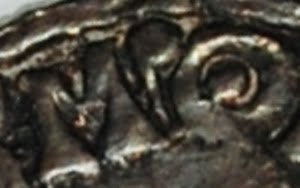
On the reverse of the same coin, further ways to abbreviate words are seen:


LEEDS.N.2010.0059.0003.R

On the left hand side, between the M and the O is a hyphen. At the end of the legend is a high pellet. In the middle over the A is a superscript line. The hyphen shows a contraction of the MONETA (meaning money) to M-O:

The pellet shows a contraction of the name EORFORPIC (York) to EO.:


The superscript line shows another contraction, this time of an entire word, ANGLORUM, to a single letter A:


However these conventions are not static and they do alter between different coins, or rather, different moneyers used different conventions particular to themselves to contract different words.

LEEDS.N.2010.0060.O

In this example the –rum of Anglorum is shortened by a pellet inside the O, rather than with a conjoined x.


On the reverse of the coin the contractions of Moneta and Eoforic are also shown differently:

LEEDS.N.2010.0060.R

An apostrophe, as well as a central pellet contracts Moneta:


And Eoforic is contracted by an internal pellet, not even at the end of the letter group:


Multiple marks of the same type are used as well. In this example, a double pellet stands in for the –m at the end of Anglorum:


The study of abbreviations in manuscripts and their similarities to those on coins is an area that has not been systematically studied. Conventions from manuscripts are certainly brought into the die-cutting, but are they standardised? This brief survey suggests large differences between die-cutters who were producing coins and the choices of abbreviation that they made. It appears too that there is an awareness of how abbreviations were used in manuscripts and the letter formation there.

All the coins discussed here date to the early eleventh century under the reign of Ethelred. This is a “middle period” according to Bischoff in Latin Palaeography where “a supply of abbreviations and their usage was established”. Bischoff is telling us that at the same time as these coins were being made, conventions within manuscript tradition were not set yet. It is a period of transformation and standardisation for the different media that used writing. Coins should be very much included!


Lucy Moore


Sunday, 6 January 2013

Time is fleeting.....

Re-assembly at LMDC
Harrison clock movement being prepared for transport


Hindley telescope in its showcase for Keeping Time 


Matthew Read preparing the telescope for transport


The "Keeping Time" exhibition at Fairfax House, York, ended on 30 December 2012, and Friday 4 January 2013 two of the star items, the John "Longitude" Harrison clock, of 1727, from Leeds Museums and Galleries, and the Henry Hindley telescope, of 1742, from Burton Constable Hall, were dismantled and prepared for transport with the expert help of Matthew Read, clocks programme tutor at West Dean College, and one of his students, Tim Hughes. The Harrison clock is safely back at Leeds Museum Discovery Centre. The Hindley telescope is at West Dean College now for an extensive programme of conservation and recording, a project that is being funded by a very generous donor, Josie Rowland. The telescope has been blogged about before, it is of tremendous importance within the history of scientific instruments, being the first-ever equatorially mounted telescope, with some technical details about the thread-cutting that has even Matthew a little puzzled. The full dismantling, recording and analysis should be very revealing. The other one made by Hindley is at the Science Museum. There will be blogs about this project as it progresses. The aim is to share the information gained as widely as possible, and to that end a study day is planned, as are papers for Antiquarian Horology Society, and the Scientific Instrument Society. Its display and interpretation at Burton Constable Hall will be informed by what is revealed, as well as the historic context. The dance of communication between curator, conservator and education specialists is what creates the unique offer for visitors that great museums aspire to, and the curatorial committee at Burton Constable Hall, of which I am a member, is looking forward to making the most of this unique and significant navigational and astronomical instrument.

Antiquarian Horological Society
Scientific Instrument Society
West Dean College
http://en.wikipedia.org/wiki/Henry_Hindley
Burton Constable Hall
Equatorial mounts

Posted by Ian Fraser


Friday, 14 December 2012

An evening dress by Norman Hartnell

Last time I wrote about festive party frocks of early 20th century, and promised to continue on the subject. Recently I came across a lovely evening dress from 1930s, designed by Norman Hartnell, and I just had to write about it.


Norman Hartnell (1901-1979) was one of the most prominent British designers of the 20th century, and also dressmaker for Queen Mary, Queen Elizabeth, and Queen Elizabeth II. He started his own company in 1923, after leaving Cambridge without a degree and working with other designers, such as Lady Duff-Gordon, better known as Lucile.

Hartnell’s style was opulent and decorative and he specialised in lavish embroideries employing an in-house embroidery workroom. He offered British haute couture for both domestic and foreign clientele, specializing in creating ethereal and alluring evening gowns and afternoon dresses for the elite, but he also produced variety of ready-to-wear, shoe, perfume, jewellery, bridal and menswear collections over the decades.
However, he is best remembered for dressing the royals. Hartnell gained the favour of the court when he designed the wedding dress and trousseau for Lady Alice Montagu-Douglas-Scott, marrying Duke of Gloucester in 1935. After that, both Queen Mary and Duchess of York, future Queen Elizabeth, became clients, and especially following the abdication crisis Hartnell became responsible for Queen Elizabeth’s wardrobe. She was so taken by Hartnell’s designs that she commissioned him to design the wedding and coronation gowns for Queen Elizabeth II and a wedding dress for Princess Margaret. In 1940 Hartnell received a Royal Warrant for his accomplishments and in 1977 he was appointed Knight Commander of the Royal Victoria Order.


The dress in the museum’s collection is from the 1930s when Hartnell was a praised and very sought-after designer. It is a full length silver lame evening dress with a train, and it also has a matching coronet and an underdress that goes with it. We do not know who the dress belonged to, but behind the dress label there is another label saying “Lady M oraan”.


The dress is sleeveless and it has shirring at the bust and an open back with imitation belt on the back side. As is common with dresses of this era, it is bias-cut to accentuate the body lines and drape more softly. The cut of the dress is very interesting in other respects too, since the back side seams are very cleverly cut in zig zag pattern also helping to accentuate the body lines.


The dress closes on the left side seam with hooks and eyes and the side of the hooks changes on the waist seam, creating more secure closure. There is also an egg blue waist tape inside. Narrow straps with press stud closure are sewn inside the shoulders to secure the straps of the underdress in place.

The matching coronet is made of same silver lame as the dress and it has an elastic band sewn on it. Metal wire is twined inside the silver lame braids to form a plait.


The underdress worn with the dress is of egg blue silk with silk chiffon hem and cream shoulder straps. There is a label inside revealing it was bought from Marie Thérèse Gowns, 47 Conduit Street, London. Conduit Street is situated just next to Bruton Street in Mayfair, where Norman Hartnell had his salon throughout his life. The owner of the dress has probably first had the dress done at Hartnell and then bought the underdress from a nearby shop.

For more information on Norman Hartnell, visit http://www.normanhartnell.com.


Piia Lempiäinen